Oppo have just released the Oppo HA-2 SE which I reviewed yesterday. Click HERE to read the Oppo HA-2 SE review.
However, what you all wanted to know is how does the Oppo HA-2 SE differ to the original award winning Oppo HA-2. First up, check out the video below to see what’s different on the hardware and accessories.
Video Comparison
Sound Quality
So the Oppo HA-2 has the DAC and the HA-2 SE has the new DAC. The new DAC provides a much lower noise floor, which means sensitive IEMs are unlikely to hear any hiss. Also the “SE” now has 32 bit audio instead of 24 bit.
But specs are all well and good, but what matters is the sound quality. So what I did was test both devices using my Oppo PM3 headphones using the 3 tracks below. I have highlighted the audio differences with each song.
Track 1 – Dancing on the Edge, The Louis Lester Band – Down River
The Oppo HA-2 lacks the sparkle in the treble that the HA-2 SE possesses. The HA-2 is more dynamic and provides a slightly wider sound stage.
Track 2 – Bastille – All This Bad Blood – These Streets
The HA-2 SE has better clarity and definition. The original HA-2 feels muddied sometimes. I think the differences I am hearing is due to the lower noise floor, allowed the HA-2 SE to produce better treble and mid range across the track.
Track 3 – Offenbach: Les Contes D’Hoffman (Disk 1) – Prologue: Glou! Glou! Je Suis Le Vin!
The HA-2 SE once again has the edge over the HA-2. The precision in handling all the frequencies and scaling is slight ahead of the HA-2. I also prefer the mid and treble and overall musicality from the HA-2 SE. The vocal parts from this track felt more realistic from the HA-2 SE over the HA-2.
Conclusion
The Oppo HA-2 SE with its new DAC improves the musicality, dynamics, treble, detail and reduces the noise floor too. The Oppo HA-2 SE provides a decent update over the original HA-2 and consequently is highly recommended. I like the HA-2 SE so much over the HA-2 that I spent the whole weekend listening to all my favourite music!
Welcome to my review of the Oppo HA-2 SE. The Oppo HA-2 SE is the upgraded version of the legendary Oppo HA-2, that I reviewed back in February 2015. Click HERE to read the original review of the Oppo HA-2.
Since Oppo released the HA-2, the world of personal audio has exploded. However, the improved Oppo HA-2 SE remains in a class of its own. Read on to find out why.
The Basics
– It is a Portable Headphone Amplifier and DAC
– High-resolution USB DAC for Apple/Android/PC/Mac
– Two gain settings for optimal headphone matching
– Mobile power bank for charging your phone
– It looks gorgeous and sounds fantastic
– It has Oppo’s VOCC fast charging. Only 90 mins to recharge the HA-2 SE.
– The HA-2 SE is improved by upgrading the DAC from the ESS Sabre32 Reference ES9018-K2M chip to the new ESS Sabre32 Reference ES9028-Q2M
Video Review
Oppo HA-2 vs Oppo HA-2 SE – What’s Different? I have a dedicated post highlighting all the differences between these models Click HERE..
The Design
Before I go to discuss the specifications and sound in more depth, lets take a look at the box and its contents. The Oppo packaging is top notch. Everything is neatly organised in the box which includes the Oppo HA-2 SE itself, the VOCC charger, a short lightning cable, a OTG micro USB to micro USB cable, a 3.5mm to 3.5mm cable, 2 rubber bands for securing it to another device and detailed instructions. The Oppo HA-2 SE simply stands out as a solid, well built and gorgeous looking device (see photos and video). It does not need a case as it is bound in leather.
The Specifications
Full specifications –
– Dimensions (W x H x D) 68 x 157 x 12 mm
– Weight 175 grams
– Frequency Response 20 Hz – 200 kHz
– Audio-in Level 1 Vrms
– Line-out Level 1 Vrms
– Recommended Headphone Impedance 16 Ohm – 300 Ohm
– Maximum Headphone Output Power 300 mW into 16 Ohm,220 mW into 32 Ohm, 30 mW into 300 Ohm
– Headphone Amplifier Impedance 0.5 Ohm
– Output Jacks 3.5 mm stereo headphone
– 3.5 mm stereo line-out
– Input Ports Analog: 3.5 mm stereo audio-in
– Digital: USB A for iPod / iPhone / iPad; USB micro-B for smartphones with USB OTG feature and computers.
– DAC Chip ESS Sabre32 Reference ES9028-Q2M
– Input Format Stereo PCM, Stereo DSD (DoP v1.1 or native)
– PCM Sampling Frequencies 44.1 kHz – 384 kHz, 16 / 24 / 32-bit
– DSD Sampling Frequencies 2.8224 MHz (DSD64), 5.6448 MHz (DSD128), 11.2896 MHz (DSD256, native mode only)
– Profile USB 2.0, USB Audio 2.0
– Included Accessories Power Supply Unit (Rapid Charging Charger)
– USB A – USB micro-B data and rapid charging cable
– USB A – Lightning data cable (for Apple devices)
– USB micro-B to micro-B data cable (for Android and other smartphones)
– 3.5 mm – 3.5 mm stereo audio cable
– Silicone rubber band (2 pieces)
– User guide and warranty documents
– Battery Built-in Battery type 3000 mAh lithium polymer rechargeable battery
– Battery Operation Time Approx. 13 hours for analog source via Audio-in; approx. 7 hours for digital sources via USB
– Charging Time Approx. 1 hour 30 minutes
The Technology in More Detail
Ok, so what makes the device really special. The Oppo HA-2 SE is a Hybrid Class AB Amplifier with integrated circuits and discrete transistors. Oppo uses hand-picked and matched parts for the discrete transistors. The output transistors are biased to operate in their most linear range for the critical small signal, and deliver their full potential when power is required. This was most noticeable for when I was listening to music that scaled up suddenly.
The Oppo HA-2 SE is “MFI” Apple certified and is compatible with the latest iPhone 7 and iPhone 7 Plus, iPod, and iPad, meaning it can be use the digital audio output via the supplied lightning cable. The HA-2 SE does not need the Camera Connection Kit. I tested the HA-2 SE with an iPhone 7 Plus and the iPad Air and all worked as advertised. In fact with Apple removing the headphone jack on the iPhone 7, this is the perfect solution for bringing back the use of the 3.5mm headphone jack and at the same time providing an improved audio experience.
Android – The HA-2 SE’s micro-USB input port works with Android devices that support USB OTG (USB On-The-Go) and USB Audio Class. A special USB OTG cable is supplied with the HA-2 SE to facilitate the connection. When used with a compatible Android device, the HA-2 SE can support the device’s built-in music app, tones and notifications. Additionally, a high-resolution music playback app can use the HA-2 SE as its external DAC to play lossless PCM and DSD audio files eg USB Audio Player Pro app for android.
Audio-In and Line-Out – The HA-2 SE has a 3.5 mm Audio-In port to support portable music players that do not have a USB-compatible digital output. While the HA-2 SE is used with one of its USB digital input ports, the 3.5 mm jack acts as Line-Out for the USB DAC.
And now on to the crown jewels of this device. ESS Sabre32 Reference DAC – The DAC is one of the most important components for digital audio playback. The ES9028-Q2M DAC chip used in the HA-2 SE is the latest flagship mobile DAC developed by ESS Technology. With the ESS patented 32-bit Hyperstream™ DAC architecture and Time Domain Jitter Eliminator, the SABRE32 Reference DAC delivers an unprecedented performance for mobile applications. The performance and quality of this DAC is outstanding and a noticeable improvement over the DAC used in the original Oppo HA-2.
Asynchronous USB DAC – The HA-2 SE can bypass the smartphone’s built-in DAC and headphone amplification circuit that are often cost-constrained. The asynchronous USB DAC input of the HA-2 SE also works with PC and Mac computers to replace the built-in sound card and support high-resolution audio playback with PCM up to 384 kHz 32-bit (the original HA-2 only supported PCM up to 384 kHz 24-bit) and DSD up to 12 MHz (DSD256).
Clean Signal Path – There is no DSP (Digital Signal Processor) in the HA-2 SE. Volume control is operated by a combination of the DAC chip’s internal digital volume control and an analog potentiometer (the volume knob). Bass boost is performed by pure analog audio circuits. By avoiding re-digitising the audio signal for volume adjustment or bass boost, the HA-2 SE provides a clean signal path for the audio. And the difference is noticeable in playback.
Bass Boost – HA-2 SE offers a Bass Boost function. With Bass Boost off, the HA-2 SE delivers a ruler-flat frequency response; with Bass Boost on, the HA-2 SE adds force and impact to the sub-bass region without muddling the important mid- to high-frequency bands. In reality, I found I didn’t need the bass boost, although I can’t deny it wasn’t fun to use at times.
Two Gain Settings – The HA-2 SE offers two gain level settings for optimal headphone matching. The High Gain mode is capable of driving large power-hungry headphones, delivering up to 300 mW into 16-Ohm headphones. The Low Gain mode is intended for sensitive In-Ear Monitor type earphones. With the new DAC in the HA-2 SE this makes a big difference with sensitive IEM headphones, removing the background hiss that did occur with the previously DAC.
Rapid Charging – The HA-2 SE features patented VOOC rapid charging technology from OPPO. Using the supplied rapid charger, the internal battery can be quickly and safely charged to 75% capacity in about 30 minutes. It only takes approximately 90 minutes to fully charge the battery. A quick charge gives the HA-2 SE up to 13 hours of operation time.
Mobile Power Bank – The HA-2 SE functions as an external battery pack to charge your mobile device.
The Sound Quality
So what really matters ultimately is how does the Oppo HA-2 SE sound. For this test I used the following headphones: Sennheiser HD598 SE and Oppo PM-3. Genres used – Jazz, Blues, Pop, Rock, Female Vocal. I used my Apple iPhone 7 Plus and iPad Air as the source. I had zero issues with connectivity. The Oppo HA-2 SE has Apple’s MFI certification and includes a lightning to USB small connector.
Sally Barker – To Love Somebody/Dear Darlin – With both headphones the vocals, guitar and the extra detail extracted by the HA-2 SE was exquisite. Sally Barker’s voice sounded so delicate and emotional. Plus the new ES9028-Q2M DAC seem to extract so much detail. The Oppo PM-3 headphones with the HA-2 SE were such a magical pairing listening to Sally Barker’s voice.
Adele – Rumour Has It/ Lovesong – vocals, drums, instruments and the beat – all so well captured and played. The musicality of the HA-2 SE was present in abundance. Good speed and attack and sound stage. Again comparing the 2 headphones, both sounded excellent but if I had to pick my favourite for these sounds it once again goes to the Oppo PM-3.
Paloma Faith – Can’t Rely on You – punchy, musical and a superb presentation. Plenty of bass but not overkill. The bass boost is nuts and so powerful in the sub bass, I had to turn the volume down. A similar discovery occurred again with the Oppo PM-3 headphones. With this new Sabre DAC and the HA-2 SE the combination is electric. My Sennheiser HD598 SE felt totally outclassed by the Oppo PM-3.
Yolanda B Cool & D Cup – We No Speak Americano – even without the bass boost, the Oppo PM-3 were being phenomenal. Of course, I had to flip the bass boost mode too, and bass freaks will love it in this mode. Again, a detailed musical presentation. Vocals are so good. The timing is astonishing too.
The Louis Lester Band – Downtown Uptempo/ Sweet Mary Jane – such great musicality, beat, bass, vocals, wide soundstage, instruments clearly placed in different positions. If you get this device, you must listen to Sweet Mary Jane – you will be blown away at just how good this track sounds across all headphones. But if you want to be transported in audio nirvana, you need the Oppo PM3 headphones.
Queen – Bohemian Rhapsody – what’s not to like. Superb presentation again.
Bastille – Weapon/ the Driver – the electronic sounds and fast beat really well delivered. Great vocals again and tons of attack.
Nicola Benedetti – The Lark Ascending – mesmerising delivery. Frighteningly amazing. Brought my hairs up on my arms. The music scales up as the drama unfolded too.
Sound Quality Takeaway – The new ESS Sabre32 Reference ES9028-Q2M DAC is a musical beast. It provides superb vocals, separation and low floor noise and made me want to listen again to all my music. Each time I listened to the Oppo HA-2 SE I was hearing my songs in a new light.
Final Thoughts
There are many portable headphone amp dacs available now. However, none match the Oppo HA-2 SE for its style, looks, flexibility, portability and sound quality. At £289 its an absolute tremendous recommendation. I totally LOVE IT !!
Welcome to my review of the Polk BOOM Swimmer Duo. The Polk BOOM Swimmer Duo is a great bluetooth speaker. I am having a blast using it and it has replaced all bluetooth speakers in my home. Now watch my review to find out more, and watch it dance too! The recommended retail price of the Polk BOOM Swimmer Duo is £49.99.
Video Review
The Polk BOOM Swimmer Duo Lowdown
Waterproof – The Polk BOOM is IPX7. That means it can be immersed in up to 3 feet of water for 30 minutes. Take it to the pool, ocean, and even the shower. Bottom line — just soak it and boogie away.
Dirtproof – Completely sealed from dirt, dust, mud and sand, the Swimmer keeps all filth out and your favorite tunes on full blast wherever you adventure. Journey on!
Shockproof – The Swimmer’s rugged rubberized exterior is built to absorb the drops inherent in any great adventure. Leave your worries at the door and don’t worry about dropping it.
Key Specifications
– Power Ouput: 2.5 Watts
– Battery Type: Lithium-ion Polymer 3.7 V, 430 mAh
– Battery Charge Time : 2 hrs at 0.5A
– Frequency Response: 220Hz – 20kHz
– Signal-to-Noise Ratio: > 75 dB
– Transducer: 30 mm full-range suspended within 45 mm passive-radiator
– Bluetooth Version: v4.1
– Bluetooth Support: A2DP v1.3, HFP v1.6, HSP v1.2, AVRCP v1.5, SPP v1.2
– Bluetooth Transmitter power: 8 dBm
– Bluetooth Transmitter Frequency Range:2.402 – 2.480 GHz
– Battery Life – 8 Hours
– Link 2 for stereo
– Answer calls, end calls, adjust volume and tracks
Final Thoughts
When I first got my Polk BOOM Swimmer Duo my expectations were blown away from the moment I turned it on. The sound is loud and punches way above its weight. Its versatility from being waterproof, dirtproof, shockproof and attachable to clothing, walls, chairs and more make it a clear win and recommendation.
Tech Addicts Podcast is back again with new episode starring Gareth Myles, Jay Garrett and myself. Tech Addicts is released every 2 weeks.
To listen to the latest episode subscribe by searching “Tech Addicts” within your favourite podcast app, iTunes, Google Play Music Podcasts or use the URL “mobiletechaddicts.libsyn.com/rss” to add directly.
Or listen below using the in-built player. Have fun listening!
My Beats Solo 3 Wireless headphones arrived yesterday. I was very excited to open the box and test these for a number of reasons. Firstly, the packaging and presentation is first class. When you open the box, the headphones themselves are folded inside a protective case. Lift the case out and you get the cables and extras that come with the headphones.
The second reason was to see what difference the Apple W1 chip made to the bluetooth process, setup, sound and real world usage.
I had watched the videos from Apple showing how the AirPods that also have the W1 chip, just connect by opening the protective case. I honestly did not believe it would work “magically” as shown, but the Beats Solo 3 Wireless headphones did just connect to my iPhone 7 “magically”. I simply pressed the power on button on the headphones, a big notification instantly appeared from the bottom of my iPhone asking if I wanted to connect. I tapped “connect”. And that was it. The first connection was over in a second. Not only that it named the Beats “Gavin’s Beats Solo 3” as you can see.
Not only does it pair instantly, every time I have turned it on and off and on again, it connects like a bullet. But it doesn’t stop there. Now that I have paired it to my iPhone, it is now paired to my Apple Watch, iPad and MAC using iCloud. So neat.
So what do these £249 on ear headphones sound like? Well, not £249 headphones IMO. More like £150 headphones but I am still burning these in. Over the last hour, they have improved a lot. At the moment they do not sound as good as my Sennheiser Momentum Wireless 2.0 or B & O Beoplay H5 headphones. They have improved since the last hour and I am listening to them as I type this and I am noticing better mids and treble occurring. Once I have burnt these in for 50 hours, I will let you know my final thoughts on the audio quality. However, it is worth remembering part of the pricing is paying for the Beats branding and the Apple W1 processor and included technology.
The headphones have controls on the left earcup to activate Siri, take and receive calls, control your music and volume. They feature dual beaming microphones for clearer calls. Siri worked perfectly, but I need to test voice calls to see how they perform. One feature of these headphones is the 40 hour battery life from one charge, and the quick charge option that gives 3 hours playback after a 15 min charge from a low battery.
So have Apple invented bluetooth. No. But they have made the experience amazing. This is by far the quickest and easiest pair of bluetooth headphones I have ever paired, used and connected. Also, the signal has not dropped, not even once, not even for a blink of an eye.
My final thought is this – “Why are you wasting your energy, plugging headphones into a 3.5mm headphone jack or lightning port?”. Wireless is the future and the future is now!
Welcome to my review of the Bluedio V (Victory) Pro Patented PPS 12 Drivers Wireless Bluetooth Headphones.
With the removal of the headphone jack in the new iPhone 7, wireless headphones are going to explode in popularity. In fact in the last 12 months, 53% of all headphones bought were wireless.
The Bluedio V headphones use patented technology so I do recommend reading the key features and specifications below.
Key Features / Specifications
– PPS 12 Exclusive Acoustics Technology specially built with 12 drivers. Paired with a carefully designed compound cavity these headphones will accurately reproduce every frequency, ensuring an immersive, DEEP and POWERFUL BASS.
– Transcendent S/PDIF Optical Transmission. HD sound is available through the professional S/PDIF Optical Transmission audio jack. Combined with 24bit@48kHz audio resolution, this enables the transmission of the highest quality DIGITAL sound.
– Lossless Aptx transmission Aptx coding-decoding will recompile the high-quality audio to bring you a rich listening experience. With downward compatibility, not compressed and partially compressed audio (such as MP3, aac & flac) can also be clearly transmitted via Bluetooth.
– Share music wirelessly between two headphones. Automatically connect two pairs of Victory headphones by simply entering pairing mode and enjoy all your favourite music with your friends.
– Touch controls. Simply touch, swipe and drag your finger across the ear cup to change volume and skip track.
– Bluetooth version: 4.1 – Bluetooth operating range: up to 10m
– Frequency range: 2.4GHz-2.48GHz , Frequency response: 10Hz-22,000Hz
– SPL – 112db
– Drivers: 50mm x 2; 30mm x 2; 20mm x 8
– Impedance: 42Ω (50mm); 32Ω (30mm); 32Ω (20mm)
– Bluetooth profiles: aptx®, A2DP, AVRCP, HSP, HFP
– Digital audio decode format: IEC-61973, PCM(24bit@48KHz)
– Audio supported – AAC, APT-X, APT-X Low Latency, SBC & Fastream
– Optical music time: about 40 hours
– Bluetooth music/talk time: about 25 hours , Standby time: about 1000 hours
– Charging time: 2.5 hours for full charge
– Headphones dimensions: 17.6cm*9cm*18.8cm
– Headphones weight: 446g
– In the box – Bluedio Victory Bluetooth headphones , 3.5mm audio cable ,6.3mm patch plug,User manual Carrying case with a buckle, USB charging cable, Pouch for cables ,Optical audio cable with adapter
– Note 1. Gently push the On/Off button to enter pairing mode, and you will see the red and blue light flash alternately.
– The 3.5mm audio jack on both two sides of the headphones are useful; while the S/PDIF input jack is on the right ear cup.
– The aptx low latency profile is closed by default because iOS and some Android devices don’t support it. If necessary, please contact our customer service to download the specified App to open it.
The Technology
Bluedio invested 1 million yuan in purchasing BK Acoustics test equipment which comes from Denmark. The aim of this was to create the perfect environment, zero noise room, to create the best timbre sound from these new patented flagship headphones from Bluedio. Their 12 driver setup is patented too.
Each headphone has 6 drivers, making a total of 12 drivers for these headphones. Above is the breakdown of one side, and below the internal tech driving the setup.
As a surprise and rather unsual, Bluedio added the option to connect these digitally using a S/PDIF optical connection and supply the cable too.So you connect these directly to the optical out of a CD player for example. The Bluedio V (Victory) also supports AAC, APT-X, APT-X Low Latency, SBC & Fastream. You can also connect another Bluedio headphone wireless to another and share the music.
Build Quality & Operation
The Bluedio V (Victory) headphones are built like tanks, and are also heavier than most at 446g. The extra weight is noticeable and takes a while to adjust to it. The headphone cups swivel up into the band, which is different to most headphones that fold. The right ear cup has touch controls for adjusting the volume, and changing tracks. You can also make phone calls from the headset.
Sound Quality
I have connected these to my laptop, chromebook, Wileyfox Swift, Samsung Note 7 and iPad. I have tried all genres. On first listen, I found the sound strange. The 12 driver setup was reproducing music differently to what I was used to. Plus the sound seemed too sharp. At this point I was ready to return these but I was too busy to sort out. So I decided to give these another shot, left music playing for about 10 hours to burn the drivers in, and then had another listen. Oooh. Much better now. In fact, the longer I have owned these the more I like listening to them. They don’t do floppy sound, the reproduce accurate and powerful bass (not floppy bass) and have a great soundstage. A word of warning. These go so bloody loud they could blow your ears off. So make sure before you hit play, make sure you have the bluetooth volume very low. Important to remember this. The Bleudio also support APT-X low latency but to turn this feature on, you need to email Bluedio who provide an app, the turns this on.
Conclusion
The Bluedio V(Victory) PPS 12 Driver Patented Wireless Bluetooth headphones are a surprise package. The sound good and can go very loud if required. The only caution is their weight at 446g. However, I like these and consequently are recommended.
For more info and the latest pricing on Amazon – Click HERE.
So you have just got the new phone and want to buy some new wireless bluetooth headphones. Below are my reviews of the best bluetooth wireless headphones of 2016. These headphones also are fantastic with many other devices too.
Welcome to my review of the Lindy USB DAC and Headphone amp.
Key Specification
– Provides audiophile sound quality up to 24bit/192KHz (96KHz maximum for USB)
– Accepts 2 channel digital audio and works with any PCM stream with Dolby Digital or DTS disabled
– Built-in headphone amplifier and TosLink Optical, SPDIF Coaxial and USB Digital Audio interfaces
– Input selector switch and headphone volume control
– USB 2.0 interface compatible with Windows XP/Vista/7/8 and Mac OS X (no special drivers required)
– Can be powered via the USB bus or an additional USB power supply (not included)
Main Review
Lindy has released a USB DAC to for less than £50 which will enhance any digital music collection by upgrading the sound quality from PC, HDTV, CD/DVD player or other audio device.
The USB DAC fits discreetly alongside the selected audio player, and outputs to headphones, amplifiers or powered speakers via a 3.5mm stereo headphone jack or analog phono stereo output. Optical, Coaxial and USB inputs allow for a variety of music sources, with the USB 2.0 input compatible with Windows XP onwards, Linux and Mac OS X with no special drivers required. The LINDY USB DAC also supports hi-resolution music up to 24-bit/192kHz.
I connected the Lindy USB DAC to my computer and plugged in various pairs of headphones. The Lindy USB DAC improved the overall sound quality. Based on the specifications, I would not recommend connecting headphones over 150 ohms.
The video review below includes the remainder of the review as well as further technical information.
More information and the latest pricing on Amazon Click HERE.
Conclusion
A budget priced USB DAC from Lindy which does exactly what it says on the tin.
Welcome to my review of the Lindy CROMO IEM-75 Dual Driver in ear monitor headphones.
Key Specifications
Driver Diameter: 15 and 7mm (dual driver)
• Frequency Response: 8-20kHz
• Impedance: 26 Ohm
• Sensitivity (S.P.L.): 105dB ±3dB(@1kHz with 1mW input)
• Nominal THD: <3% (@1kHz with 1mW input)
• Max. Power Input: 50mW
• Cable Length: 1.2m (0.85m to split, 0.35m from split to each earpiece)
• Connector: 3.5mm stereo
• Weight: 16g
Main Review
The Lindy CROMO IEM-75 dual driver design has been developed to deliver a more spacious and defined sound. Each earpiece contains a 15mm driver for bass and midrange and a 7mm driver for high frequencies, which are then tuned within the acoustic chamber to deliver high quality and accurate sound. The housing is a black chrome aluminium enclosure, which offers rigidity for the drivers when playing music. What is impressive is the price. Just £69.98.
In the box there are 3 sizes of super-soft ear tips. The CROMO IEM-75 comes with an attached 1.2 m cable, which is terminated with a 3.5 mm gold-plated stereo jack plug. Also included within the box is a carry pouch to protect the CROMO IEM- 75’s when not in use. The headphone cable is thin and not user replaceable.
I tested the Lindy in ear headphones using my Samsung Galaxy S7 and also using a headphone amplifier – the Oppo HA-2 and iBasso D14 Bushmaster. The good news is these in-ear monitors are relatively easy to drive straight from my Samsung Galaxy S7, but like all headphones using a dedicated amplifier adds extra control, finesse and drama. Lindy classify these as in ear monitors with a dual driver setup. One driver for the mid and bass, and the other for the treble. Listening to a range of genres, the CROMO IEM-75 have a distinctive characteristic that allows for the mid and treble to flourish without the bass killing the music. These are tonally accurate and at times feel like a little bass light. However, not everyone wants over processed thumping bass. With modern pop, rock, classical, jazz and blues the Lindy headphones were engaging, with nuances coming out in the tracks that I had not heard before. The sound stage was reasonable too. I enjoyed listening to these for hours on end.
The Lindy CROMO IEM-75 add to Lindy’s affordable headphone range, offering good value and sounding headphones. These are recommended for those that desire in-ear monitor sound and not an over processed bass heavy headphone.
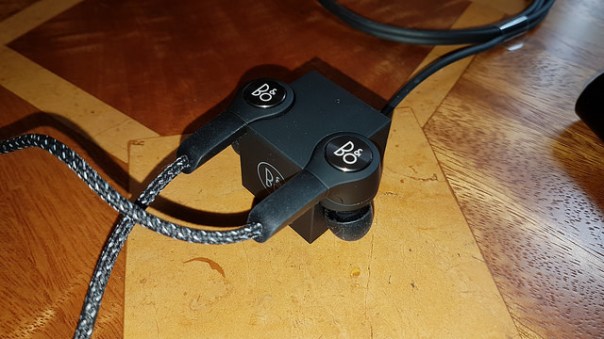
Welcome to my review of the B & O H5 Wireless headphones. B & O also call these headphones the Beoplay H5.
Key Specifications
– DIMENSIONS Earphones: 39 x 28 x 23.5 mm
– Cable length attaching earbuds: 52 cm
– Charging Cube: 28.8 x 28.8 x 29.2 mm
– WEIGHT 18 g
– MATERIALS – Aluminium/Textile/Rubber/Polymer/Foam/Silicone/Nylon
– LOUDSPEAKER – Electro-dynamic, 6.4 mm diameter
– FREQUENCY 20 – 20,000 Hz
– COLOURS Black/Dusty Rose
– DESIGNER- Jakob Wagner
– MICROPHONE Omnidirectional
– BATTERY Two rechargeable Lithium-Ion batteries (one in each earpiece)
– Capacity: 2 x 50mAh each
– Up to 5 hours playtime at moderate level
– Charging time: approximately 2 hours
– CONNECTIVITY Bluetooth 4.2
– Supports aptX, aptX-LL and AAC codecs
– BEOPLAY APP Compatible with Beoplay App which will enhance your B&O PLAY experience.
– INCLUDED IN THE BOX Beoplay H5 earphones, USB charging cube,Comply™ Sport ear tips with SweatGuard™ (S, M, L),Silicone ear tips (XS, S, M, L),Cable clip (3 pcs),Carrying pouch,Quick start guide
The Main Review
The Beoplay H5 wireless headphones are superb sounding in ear headphones. They include the AAC and APT-X codecs making them excellent for new iPhone and other Apple devices as well as android phones. The Beoplay app also allows you to change the sound signature with a range of presets and also update the firmware. I didn’t alter the sound signature.
If you own an Apple Watch, you can change the sound profile directly from your Apple Watch.
B & O included a wide choice of ear tips including Comply™ Sport that have a membrane to prevent moisture interfering with the electronics. These rugged and breathable tips create a near perfect, protective grip in the ear canal that is ideal for exercise or life on the go. And for relaxing with your favourite tunes, four pairs of silicone tips provide a relaxed, comfortable fit. However, I did find that during any exercise they would fall out. Also when the cable rubbed against by clothes the sound got picked up which was annoying.
After listening to your music, the earbuds attach magnetically together, meaning they shouldn’t fall off your neck. This also powers them off. See video below. The connecting chord appears fairly tough and should last a while. B & O also mention that these are dust and water resistant but they do not mention to what level in their technical specifications.
Being wireless headphones the battery life is limited to just 5 hours. To recharge them you have to use the cool looking but bespoke charger. The sound signature of these headphones is one of a decent level of bass, good treble and mid range. A crowd pleasing sound! I tried a range of genres and all sounded really good.
Don’t forget to watch the video review which reveals even more information and the rest of the review.
Conclusion
A high quality in ear music wireless headphone, that reproduces a lovely bass rich sound. Great with iOS devices (iPad/iPhone) and android phones with APT-X. The 5 hour battery life is the shortcoming along with a bespoke charger. However, these sound so lovely that they are now my default in ear wireless headphones. These are not recommended for running or the gym as they have a habit of falling out of your ears.
For more info and the latest pricing on Amazon – Click HERE.









 Gavin's Gadgets & Photography