Welcome to my First Impressions and Hands on with the Huawei Watch GT.
The Huawei Watch GT compliments Huawei’s wearable family. It runs Huawei’s own operating system, Lite OS. The Watch GT is an extension of Huawei eco system.
With the Watch GT, Huawei wanted to create something similar to Garmin and Fitbit. However, they also wanted the watch to look like a sports watch.
Some of the feature highlights includes a superb battery life. It has the potential for 22 hours with continuous everything. This is with GPS on and continuous heart rate monitoring. More realistic and what most people will achieve is up to 2 weeks with general usage. Or if you restrict the background activities the battery will last up to 30 days.
Apart from Huawei using their own OS, it also has their own chipset with a low and high power core, which will kick into action, depending on what’s needed by the user. Some of the fitness features include real time performace when running, a heart rate system now uses a 6 system light system to read heart rate. It uses the sensors and AI to understand where the watch is precisely placed on your wrist to give you more accurate readings. GPS location is derived via 3 different GPS systems to help triangulate more accurate and faster tracking. The Huawei Watch GT also includes an altimeter.
In terms of compatibility, the Huawei Watch is compatible with iOS and android. Data is synced and displayed using the updated Huawei Health app.
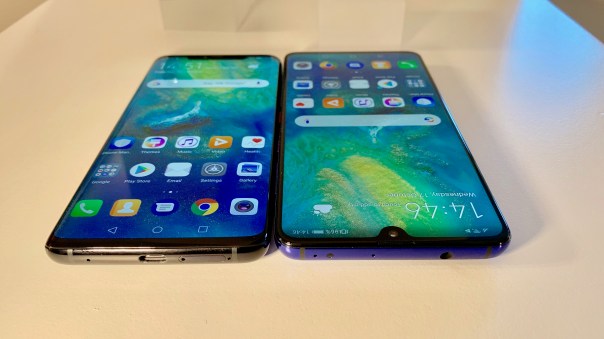
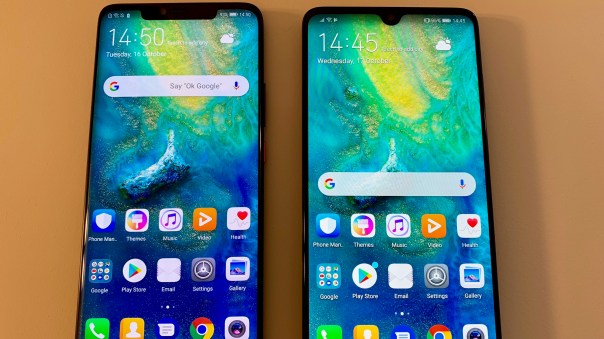
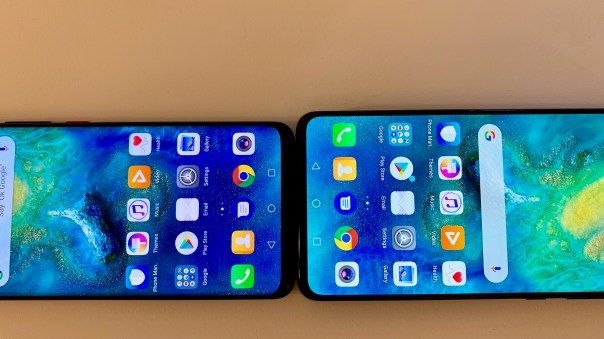
Huawei has just announced several new smartphones. So let’s take a look at the differences between the Huawei Mate 20 Pro and the standard Mate 20.
First up the standard Mate 20 has a wider body. It also lacks a notch as it doesn’t have the Dot Matrix Face Unlock system that the Mate 20 Pro includes.
Eagle eyed people will also notice the standard Mate 20 has a headphone jack.
Not shown, but both feature the same look/design of rear camera configurations, but the Mate 20 Pro comes with a superior configuration.
So which do you prefer? The Huawei Mate 20 or Mate 20 Pro?
The Huawei Mate 20 Pro is the new flagship phone from Huawei. I am very excited about this new phone, having spent some early access time using it.
Key Features
First up it features the new Kirin 980 7nm chipset, with its dual NPU. This is so important as it ups what’s possible in the photography field. Now the Huawei Mate 20 Pro can recognise the skeleton form of a human being, not just photos, but in videos in precise detail. This means it can optomise parts of images live even during video. See my video below with the sample of Video AI colour.
In terms of connectivity, the phone has Cat 21, that’s 1.4 Gigabits per second. The latest Bluetooth 5 is now included with the respective codecs.
What’s a phone without a decent battery? Well the Mate 20 Pro has a huge 4,200 maH battery. Not only that it has “Reverse Wireless Charging” – a first for a phone to share power wirelessly.
Unlike Apple, Huawei include a supercharger in the box. This is the new 40Watts supercharger that can recharge the huge battery to 70% in just 30 mins. Qi Wireless is now included at 15 watts which is double the industry standard. Both charging methods have been safety certified by independent company.
The Mate 20 Pro is all about its camera and I am sure that is what you are all most interested in. Co-engineered with Leica and taken up to the next level. On board is a 40mp RGB f/1.8 lens, 8mp telephoto with OIS, 20mp f/2.2 ultra wide sensor, dual tone flash. As the main sensor is so good now, there is no need for the monochrome sensor.
The Mate 20 Pro features nNw photo AI modes. Super macro gets as close as 2.5cm from subject. On the P20 Pro, it could identify 500 scenes and scenarios, but now with dual NPU that has risen to 1,500. The AI knows how to keeps the right stuff in focus too. There is so much to cover on the cameras, so much so, I will be creating two special posts.
The AI now extends to video with special video modes eg AI Colour video. This keeps the person in colour while the res of video is in black and white.
Security has been improved with a new 3D Facial dot matrix unlock. It can be used to secure information on the device as well. An under the screen finger print sensor is also included. Huawei’s backup now extends to NAS systems for extra versatility.
Moving over to productivity, you can now print seamlessly to a wifi printers. PC Desktop mode is now wireless enabled using a miracast enabled screen/TV. This also means you can use desktop mode indepently of the phone.
The design of the phone and camera setup is distinctive and easily identifiable. It has glass with a textured pattern to aid grip, resists fingerprints. Beautiful and practical. It is also IP68.
Accessories
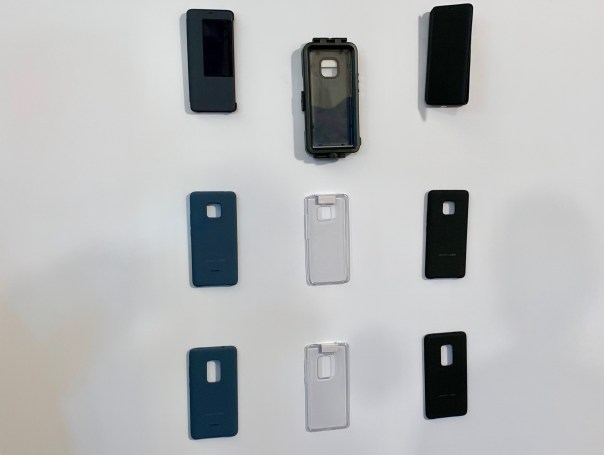
Huawei are bringing a selection of cases with the new phones as well as the new fast 15w Qi charger.
First Impressions
Conclusion
I am genuinely bowled over by the Huawei Mate 20 Pro and can’t wait to explore if further!
After a few weeks, below are my favourite and top photos that I have taken with the iPhone Xs Max.
Apple released the iPhone Xs Max a few weeks ago. Smart HDR was one of the new camera features introduced which takes multiple shots and merges the best components of each, to create one amazing shot.
Then there is the new A12 Bionic processor that helps with the computational photography aspects.
The results from the Xs Max have really surprised me. The quality leap forward from previous iPhones in very noticeable. Even from the iPhone X.
The Smart HDR even allows shooting into the sun and producing a decent result.
The Xs Max have larger pixels than the X at 1.4 microns on the main sensor. This helps with low light and detail.
Another aspect of the iPhone Xs Max Camera that I have noticed is it’s speed to take a shot. It’s instant.
Talking of speed, holding the shutter button activates burst mode. Did you know you can take 999 shots in a single burst.
With each burst, I noticed how every shot was in focus and perfectly exposed as well.
Portrait mode has improved too.
Of course, portrait mode can be used in many different scenarios.
With the Xs Max, the telephoto lens can help get some great macros.
And even without the telephoto you can get some great close up pics.
I really love how the camera captures sunsets and sunrises.
In addition, if you edit the photos in the iOS Photos app, there are some lovely filters available.
Video has also been improved on the Xs Max. The iPhone Xs Max is one amazing camera. And so easy to use and reliable.
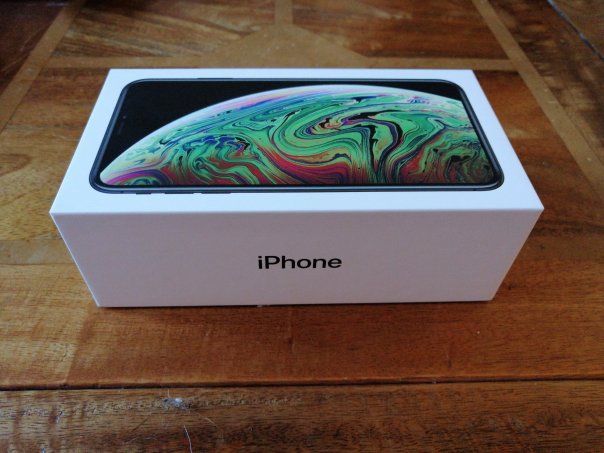
In case you’re wondering what’s in the box of the Apple iPhone Xs and Xs Max , I can confirm it includes an awful lot of goodies. So what does Apple include?
Below is the full list of what is included –
– iPhone Xs or Xs Max with iOS 12
– EarPods with Lightning Connector
– Lightning to USB Cable
– USB Power Adapter – this isn’t a fast charger adapter
– Documentation which includes an Apple sticker
– There is no 3.5mm to Lightning Headphone Adapter included
Welcome to my first impressions of the iPhone Xs Max.
Before I get to my first impressions, I came across a little gem of a case that got delivered yesterday by DPD. It’s a silicone style case that’s a copy of Apple’s own silicone case except it has protection on the bottom edge, whereas Apple’s own design is exposed. It also costs £40 less. MoKu Case
The new iPhone Xs Max in theory is just a minor update to last years X. In fact with Apple supporting iPhones up to 5 years old currently, there’s no excuse to upgrade unless you’re on a iPhone 6.
However, the new A12 Bionic processor, iOS 12, larger full screen with gestures, enhanced stereo speakers, stereo video recording and more, the iPhone Xs Max could be something special which I’ll cover off in my full review.
I’ll say this now. The camera kicks ar*e. And is substantially better than last years X in every mode.
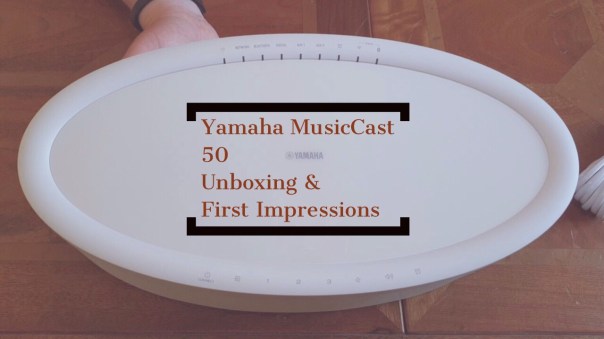
Welcome to my unboxing and first impressions of the Yamaha MusicCast 50 wireless speaker with Amazon Alexa voice control built in. The Yamaha MusicCast 50 retails for around £449.
The MusicCast 50 offers a wide range of options to listen to your favourite sounds with ease. It can be used as a standalone speaker, paired, or acting as surround speakers with a compatible MusicCast AV receiver or sound bar. The MusicCast 50 is one of the new speakers from Yamaha released in August 2018. Other features include –
– Music streaming services built-in
– MusicCast multi-room technology
– Alexa voice control compatibility* (*Availability varies by region)
– High-Resolution Audio
– Connect to a TV for upgraded sound
– Stereo pairing (requires 2 units)
– Ability to be used as surround speakers with an AV receiver or sound bar* (*Select MusicCast models only)
– Soft-touch, simple presets for instant playback
– Alarm
Built in streaming services include Spotify, Deezer, Tidal, Pandora, Napster, SiriusXM and qobuz. Apart from the multi-room options, Yamaha provide an app that allows full control of the speaker, its nultiroom options and more. MusicCast takes the headache out of multi-room audio. Simply connect all MusicCast devices to the same network and start sharing audio throughout the home. Apart from built in WiFi, it has bluetooth and Apple AirPlay. With all this functionlity, this really makes this speaker a great offering. It also puts out a respectable 70W of music.
Video
Conclusion
The Yamaha MusicCast 50 is an extremely powerful wireless speaker. It is extremely versatile too offering tons of different ways to connect to it, Amazon Alexa voice control, bluetooth and AirPlay. It is also available in black and white finishes.
Welcome to my Huawei Mate 20 Lite Tips and Tricks plus Camera.
Key Specs
– Dimensions 158.3 x 75.3 x 7.6mm
– Weight 172g
– 6.3 inch IPS display, resolution 1080 x 2340 pixels, 19.5:9 ratio, 409 ppi density
– EMUI 8.2 ,Android 8.1 (Oreo)
– Chipset Hisilicon Kirin 710
– Internal 64 GB, 4/6 GB RAM
– Rear AI Camera Dual lesnes, 20 MP, f/1.8, PDAF + 2 MP, depth sensor
– Front AI Selfie CAMERA Dual lenses, 24 MP + 2 MP, depth sensor
– 3.5mm jack
– Active noise cancellation with dedicated mic
– NFC Yes
– Radio FM radio
– USB 2.0, Type-C 1.0 reversible connector
– Sensors – Fingerprint (rear-mounted), accelerometer, proximity, compass
– Battery – Non-removable Li-Ion 3750 mAh battery
The Huawei Mate 20 Lite features automatic AI beautification. This makes your selfies stand out and is achieved as the front-facing camera has a 24 MP lense + 2 MP lens that provides the bokeh. The AI optimises the photo based on eight scene categories to capture a stunning selfie.
In addition, AI-enhanced HDR technology allows for real-time previews of HDR images and video recordings, delivering true colour images and vivid recordings even in backlit environments.
Fancy a bit of fun, You can animate yourself with AI-powered 3D Qmojis that recognise and imitate your facial expressions, movements, and voice. Create personalised Qmoji GIFs and videos for easy social media sharing. I had a blast using these features.
The rear 20 MP + 2 MP dual-camera with f/1.8 aperture allows for creative flair to be achieved for your photos with optical bokeh. The AI provides 22 categories of object and scene recognition–based optimisations that make your photos look more professional.
Slow motion. No problem. Slow down time with 16x Slow-Mo, at 480 frame per second, in 720p resolution.
The Huawei Mate 20 Lite has a 3750 mAh battery with HUAWEI Quick Charge helping keep you on the move. All phones should have decent sized batteries like the Mate 20 Lite.
When it comes to the essentials of connectivity, the Adaptive AI-driven connectivity cleverly adjusts to your environment to keep you in touch. Elevator mode quickly recovers 4G signal and optimises network performance, while HUAWEI GEO provides more accurate positioning service and improves performance even in tunnels. AI also optimises ambient noise cancellation in loud and windy environments.
Video
Huawei Mate 20 Lite latest pricing on Amazon UK – Click HERE.
Welcome to my unboxing and first impressions of the Yamaha MusicCast 20 wireless speaker with Amazon Alexa voice control built in. The Yamaha MusicCast 20 retails for around £199.
The MusicCast 20 offers a wide range of options to listen to your favourite sounds with ease. It can be used as a standalone speaker, paired, or acting as surround speakers with a compatible MusicCast AV receiver or sound bar. The MusicCast 20 is one of the new speakers from Yamaha released in August 2018. Other features include –
– Music streaming services built-in
– MusicCast multi-room technology
– Alexa voice control compatibility* (*Availability varies by region)
– High-Resolution Audio
– Stereo pairing (requires 2 units)
– Ability to be used as surround speakers with an AV receiver or sound bar* (*Select MusicCast models only)
– Soft-touch, simple presets for instant playback
– Alarm
Built in streaming services include Spotify, Deezer, Tidal, Pandora, Napster, SiriusXM and qobuz. Apart from the multi-room options, Yamaha provide an app that allows full control of the speaker, its nultiroom options and more. Apart from built in WiFi, it has bluetooth and Apple AirPlay. With all this functionlity, this really makes this speaker a great offering. It also puts out a respectable 40W of music.
Video
Conclusion
At £199, the Yamaha MusicCast 20 represents great value for money. It is extremely versatile too offering tons of different ways to connect to it, Amazon Alexa voice control, bluetooth and AirPlay. It is also available in black and white finishes.







 Gavin's Gadgets & Photography