Category Archives: Reviews

iBasso D-Zero MK2 – Portable DAC & Headphone Amplifier – Review

Welcome to my review of the iBasso D-Zero MK2 Portable DAC and Headphone Amplifier.


The Key Specifications

– Power Source:Built-in 4.2V Li-polymer battery
– Frequency Response: 17Hz~20 KHz +/- 1.0dB (DAC) 17Hz~100 KHz +/- 1.0dB (AMP)
– Signal to Noise Ratio:108dB (DAC line out), 102dB (Amp)
– Total Harmonic Distortion: 0.002%@1kHz/0dB (DAC line out), 0.003%@1kHz/-10dBV (AMP)
– Output Power:Up to 120mW+120mW into 16Ω
– Output Impedance: <0.5ohm
– Gain: +3dB/ +9dB (AMP)
– Battery Life: 120 Hours (AMP) 10 hours (DAC/AMP)
– Battery Charge Time: 5 Hours
– External Power supply: 5V DC
– Recommended Headphone Impedance: 8~300Ω
– Case dimension: 2.17W x 3.98L x 0.44H (inch)
– 55W x 101L x 11H (mm)
– Weight: 95g or 3.35oz
– Certificates: FCC, CE, RoHS


The Hardware

The iBasso D-Zero MK2 is made from an anodised aluminium housing. The front of the device features a headphone jack, aux jack, power switch with white LED and a volume controller. On the back there’s a USB output for charging the D-Zero and for connecting it to a computer, a gain switch and a USB charge switch. There’s also two LEDs a red one to indicate charging which also blinks to let you know when to charge it and an orange one to indicate USB connection. The unit features a built in battery that provides up to 120 hours play time when working as an AMP and 10 hours when used as a DAC. The D-Zero can be used with Windows PCs MAC computers OTG audio signal from an Android 4.1 or above device and the digital signal from iPhone/iPad with camera kit. The VIA Vinyl Envy USB 2.0 audio controller takes a digital signal up to 24Bit/96kHz. The DAC chipset used in the D-Zero is a Dual setup of Wolfson WM8740 DAC Chips. The OPAMP+BUF design ensures high current output allowing you to use the D-Zero with high impedence headphones.

The build quality is not as precision made as I would have expected. If you look at the mini USB socket it doesn’t quite line up exactly with the hole cut out in the aluminium body. Also why mini USB? Surely micro USB should have been used. Next the power switch looks like a  flimsy toggle. Overall, it just feels as if the component was finished by hand. That aside I do actually like the industrial look. It’s also a great compact size with flat sides for each mounting to a phone to DAP. iBasso do supply a large range of accessories with the D-Zero MK2 as shown in the photos. 

The Audio Quality and Sound Experience

Thankfully, the iBasso D-Zero MK2 sounds rather good. The Woolfson WM8740 DAC Chips have a lovely warmth to them. The D-Zero MK2 adds more bass punch to the music, with warm mids and a clearer treble. This DAC/AMP combo is musical and provides a more dynamic feel to the music. I tried several headphones and even though iBasso say this will power 300 ohm headphones, I would stick to around a max of 150 ohms to get the most out of this little black box of tricks. My Audio Technica ATH-M50x in particular paired really well with this AMP/DAC. Listening to some classical music the iBasso scaled up as the drama escalated and thumped out some very deep bass only when it was present and very quickly. What I have also found is that the iBasso sounds better after its had a 10-15 minute warm up. As a comparison I have the Fiio Q1 as well. The iBasso sounds much better than the Q1 but then it costs nearly twice as much. 

Conclusion

Priced at just under £100, the iBasso D-Zero MK2 is a great little performer with a tendency to add some warmth and impact to the music. The extra power from the amp also helps the headphones deliver a more dynamic performance. I just wish it used a micro USB connector instead of mini USB. 

More info and deals on the iBasso D-Zero Mk2 Headphone AMP and USB DAC

Sony XBA-1 – In ear headphones – review 

Welcome to my review of the Sony XBA-1 in ear headphones. 


The Key Specifications 

– Type Closed, Balanced Armature
– Driver Unit Balanced Armature

– Sensitivity 108dB (150mV)

– Power Handling Capacity 100mW

– Impedance 24ohms at 1kHz

– Frequency Response 5-25,000Hz

– Cord OFC litz cord neck-chain

– Cord Length 1.2m

 – Plug Gold-plated L-shaped stereo mini plug

– Weight (Without Cord) Approx. 3g

– Supplied Accessories Hybrid silicone rubber earbuds* (SSx2, Sx2, Mx2, Lx2), Noise isolation earbuds** (Sx2, Mx2, Lx2), Cord Adjuster (winds cord up to 50cm) x 1, Carrying Pouch x 1

* Hybrid silicone rubber earbuds (SS (Red) x 2, S (Orange) x 2, M (Green – attached to the unit) x 2, L (Light Blue) x 2)

** Noise isolation earbuds (S (Orange) x 2, M (Green) x 2, L (Light Blue) x 2)

The Audio Quality & Experience 

The Sony XBA-1 in ear headphones are known to lack bass. That statement is definitely true if you don’t use a £300-£500 DAC/Amp as a minimum to drive them. If you plug these into your smartphone directly they sound fairly neutral and lacking bass. I really didn’t enjoy the sound from these from the start. 

However after plugging these into the Pioneer XDP-100R Digital Audio Player these headphones came alive. They suddenly have the ability to deliver loads of bass but strictly only when the bass is present on the track. The mids and especially the treble are able to reproduce some fairly clear sounds with a splash of warm in their sound signature. The soundstage is not expansive. This is likely due to the closed headphone design.

Due to EC regulations new headphones sold in the Europe have the maximum volume level capped to protect your ears. I bought these from a Sony Centre who were clearing old stock for about £45. As these headphones were made prior to the changes you can reach decent volumes. 

Conclusion

These sound signature of these headphones will not be welcome by many and probably because they are not being driven by decent hardware. With the correct quality hardware powering these they truly are splendid to listen too. Not recommended for general use.

Info on Sony XBA full range of headphones

Netatmo Welcome Indoor Camera for iOS & android – review – Updated 4 months later

Welcome to my review of the Netatmo Welcome Indoor Camera.

  
The Netatmo Welcome Indoor camera unique selling point is its ability to recognise faces and then send you notifications to your phone.

See video from Netatmo below showing this in action.

The Key Specifications

– Dimensions – 45x45x155mm
– In the Box – 1 x Welcome camera, 1 x USB cable, 1 x power adapter, 1 x 8GB micro SD card
– Build – Single piece of durable aluminium shell, Matte black plastic piece infrared transparent.
– Hardware Requirements – High-speed Internet connection needed, Public hotspots not supported.
– Connectivity Specifications – Ethernet RJ-45 port: 10/100 Mbits, Wireless: Wi-Fi 802.11 b/g/n (2.4G)
– Camera – Video sensor: 4MP, Resolution: Up to 1920×1080
– Minimum iOS 8 for iPhone / iPad, Android 4.3 minimum
– Browser Support – Webapp available for the two latest versions of: Chrome, Safari, Firefox, Internet Explorer
– Monthly Costs – Nil, Free to Use, App available on the App Store / Google Play.Free access to your camera online.
– Data Storage – MicroSD card up to 32GB (8GB class 10 MicroSD card included)
– Faces – Max 16 faces

The Hardware


The Netatmo Welcome camera is a lovely piece of hardware and doesn’t look like a typical camera. This means it gets blended into your environment without people gets paranoid they are being “watched”. In fact, you forget its actually there. On the rear there is an ethernet port, micro SD card slot and micro USB port. The front is minimalistic.

Background Notes for Review

Notes – I originally reviewed this after 3 weeks. Further down is my update after 4 months following a significant firmware update that added lots of new features which are documented along with a tip if you have dogs.

I have been using the Netatmo Welcome for 3 weeks now and overall have been pleased with its operation and results and intend to keep this indefinitely as my home connected security indoor camera. I also have several IP Cameras which were a total nightmare to setup and configure as remote access involved changing my home router configuration. I have now retired these. In terms of other connected devices, I have a Netatmo Urban Weather station which is coming up to 2 years old and a range of lights that are controlled from my iPhone and or Apple Watch. Due to protecting my own privacy, screen shots of the app in operation have been edited to remove views of my home.

The Initial Setup

Netatmo have made the first setup as simply as possible. I setup my Netatmo Welcome camera using my iPhone 6S Plus. I downloaded the Netatmo Welcome app from the Apple App Store and then followed the on screen setup instructions provided by the app. The app asks permissions to share Wi-Fi setup from your iPhone to the Welcome camera and literally within 5 minutes the camera is connected. Points to note. The Welcome camera only operates at 2.4G . Over the next 24 hours a new firmware arrived and got installed on the camera and the app showed me faces and asked me to identify who the respective people were. For each member of your house, a face profile gets created.

The Operation

The concept of the Netatmo Welcome camera is simple. It learns all the faces of people who live in your home/flat and then notifies you when somebody comes home and tells you who they are and also if somebody arrives who is not recognised. When movement is detected, it records a clip onto the micro SD card which can be streamed back on to your phone and or downloaded remotely to your phone as well. When at home you can also play back the recorded video clips.


Other options include a range of privacy and advanced security options. For example if your Netatmo password gets changed, or someone logs into your account you can receive an email. Netatmo will also block your account if there are too many failed attempts occur. In terms of learning faces, you can go into the app settings and speed up the learning process. You can also tell the system when the house is empty and adjust other settings as shown below.

  
Using the app on your phone is really easy. It shows a live view snapshot when you open the app. You can then hit the play icon to stream live video. Turning your phone landscape provides full screen playback and streaming. Scrolling the screen reveals details of who is at home and or when they were last seen. Scrolling the screen the other way reveals a list of when movement was detected. Tap on one notifications and you can watch or download the recorded movement. Now if your home is broken into and someone steals your camera, you will get a notification that Welcome was switched off. The person cannot access your data and videos without your Netatmo account details. However, this also means if the camera is never recovered, you cannot view the videos stored on the camera either. However, if you sign into My Netatmo on the web you will be able to see a screen shot of each video before it started the recording of the motion.

The video quality is excellent and the camera switches to night mode which provides clear images and video as well.

As I have mentioned I have had the Netatmo Welcome indoor camera for 3 weeks now. In that time, the camera has come offline about 4 times for no apparent reasons and then reconnected a few hours later. I don’t know if its my broadband dropping although that wouldn’t surprise me as the connection does vanish occasionally. I have only had to pull the power cord out and replug back in to restart the camera just once when it became unresponsive. In terms of recognising faces this is now 90% accurate. I have relocated the camera several times to get a better position. To be honest, positioning is crucial. If the camera is recording motion to the micro SD card, it is not possible to see a live view until this has finished.

UPDATE – 4 months later, Netatmo released a major firmware update. This improved its performance and reliability but also added Dropbox support and tags. With Dropbox you can now upload video clips to the cloud instead of using the micro SD card.

wp-1467698483257.jpg

Tags are waterproof sensors for doors and windows. Photo above is one of my tags. The Netatmo tags are superb as they detect the motion before the intrusion occurs. That is because they detect vibrations. The Tags’ have an integrated open/closed state sensor, so you can choose to be alerted if you have accidentally left a window or the garage door open. And then you can check directly on your smartphone if all windows are closed.

Tips – I have 3 labradors and the Welcome camera was recognising my dogs faces. So instead of telling the Welcome camera they were not faces, I did the opposite. So now it recognises my 3 labradors and that means I don’t get any false notifications about an unknown face.

The Special Stuff

The Netatmo Welcome camera supports third apps and that extends to IFTTT. This opens up a whole world of different sequences that can be achieved. See screen shot below.

  
You can also add Welcome tags to the system, sensors for doors and windows. The other aspect I like about the Netatmo Welcome Indoor camera is once bought, there are no other costs. Its free and it has no monthly charges either.

As I mentioned already, Netatmo allow you to sign into to your camera via a web browser which uses their web app. Using a web browser, if you have other Netatmo products, you can access all the different connected devices in one go.

Conclusion

The Netatmo Welcome Indoor camera recommended retail price is £199, although if you click the link below it is available for a lot less. It provides piece of mind with its face recognition and notifications with zero ongoing costs once purchased. Add to the fact it supports third party app integration and it becomes a decent investment. It also doesn’t look like a typical camera so blends into the home environment.

And now after using it for over 4 months the added new features of tags and Dropbox integration really add to its value.

Highly Recommended.

Info and Deals on the Netatmo Welcome Home Camera with Face Recognition

All Latest Reviews from Gavin’s Gadgets – Phones, Headphones, Apps, Cameras and More

Below are all latest reviews that have published on Gavin’s Gadgets. There are plenty more reviews in the pipeline including the Samsung Galaxy S7, LG G5, new headphones, app reviews, Netatmo Welcome, Netatmo Wind Sensor, and much much more.

If you have a product that you would like me to review, please get in touch.

App Reviews

ProCamera + HDR for iOS – review

Note Tapper for Apple Watch – review

HeartWatch for iOS – review

HeartWatch 2 for iOS – review

Audio / Personal HiFi / Headphone reviews

Pioneer XDP-100R – DAP – review

iBasso DX80 plus using with Chord Mojo – review

Chord Mojo – review

Lindy BNX-60 – Bluetooth Headphones review

Ted Baker Rockall Headphones – review

Sony MDR-1RNC – Noise Cancelling headphones – review

Tascam Trackpad US 2×2 – Review

Connected / Security devices- Reviews

Fake TV – review

miGuard A105 DIY Security System review

The new Apple TV – review

The Apple Watch – One Month Review

Smartphone / iPad Pro – reviews

Asus Zenfone Zoom – review

LG V10 H960 – review

Sony Xperia Z5 Compact – review

Apple iPad Pro, Smart Keyboard, Pencil – review

Motorola Moto X Style – review

Huawei G8 – review

ProCamera + HDR for iOS – One of my favourite camera apps – review 

ProCamera + for iOS is one of my favourite camera apps for taking photos. 

  
Above is the photo snapped by the default camera app on the iPhone 6S Plus. It used HDR to take this shot. 

  
The above shot is taken using ProCamera + and its special HDR mode which brackets up to 5 shots to create one super shot. After taking the shot you can select different HDR variations to save along with the original non HDR shot. 

  
Above a slightly different HDR version and below is a HDR but in black and white. 


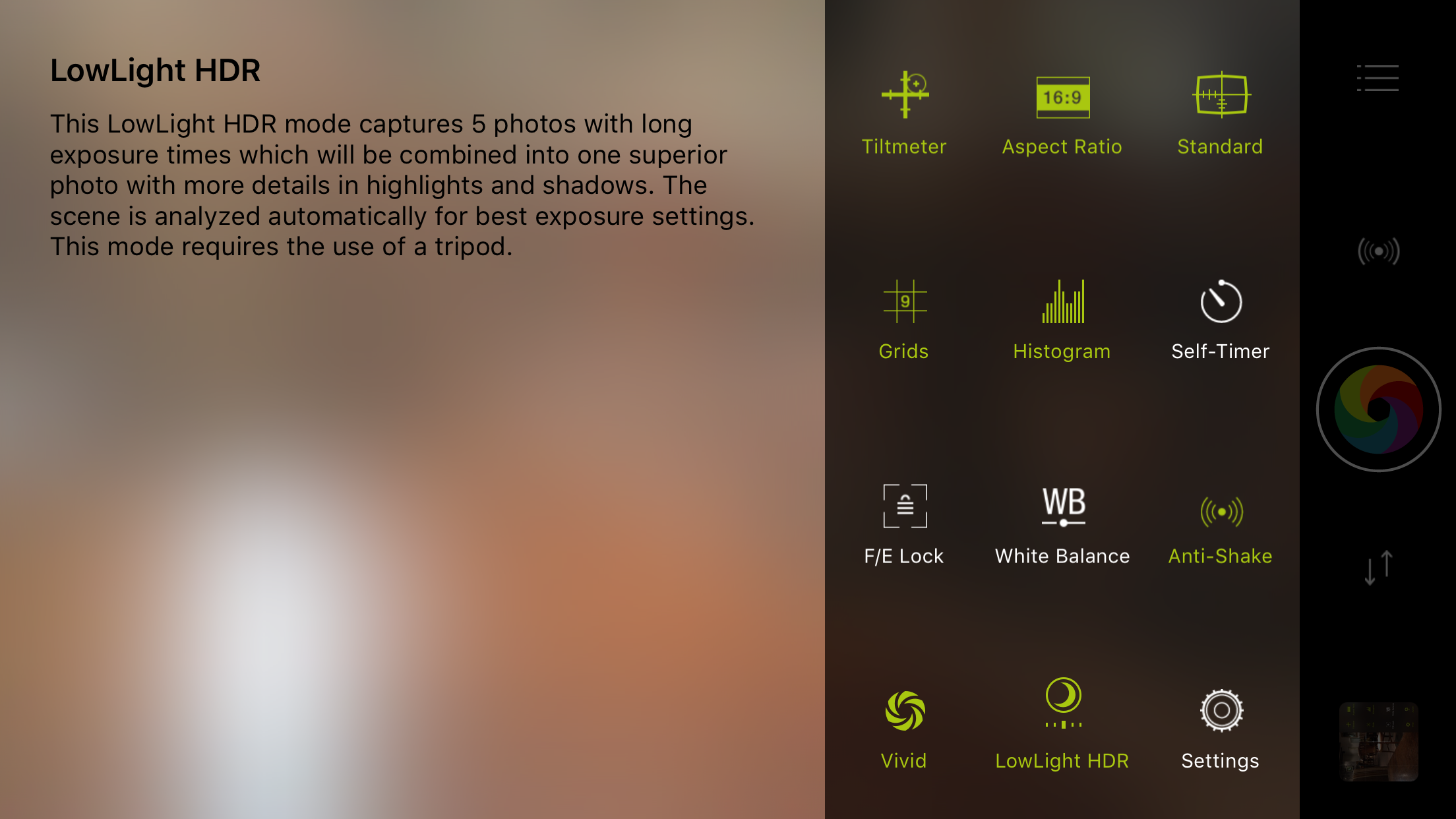
The beauty of this app is that you can have different HDR options. You can select Auto 3 brackets, Auto 5 or Auto and let the software decide. If you’re a real pro photographer then you can go manual and choose your own levels of HDR. There is even a lowlight HDR mode. 

  
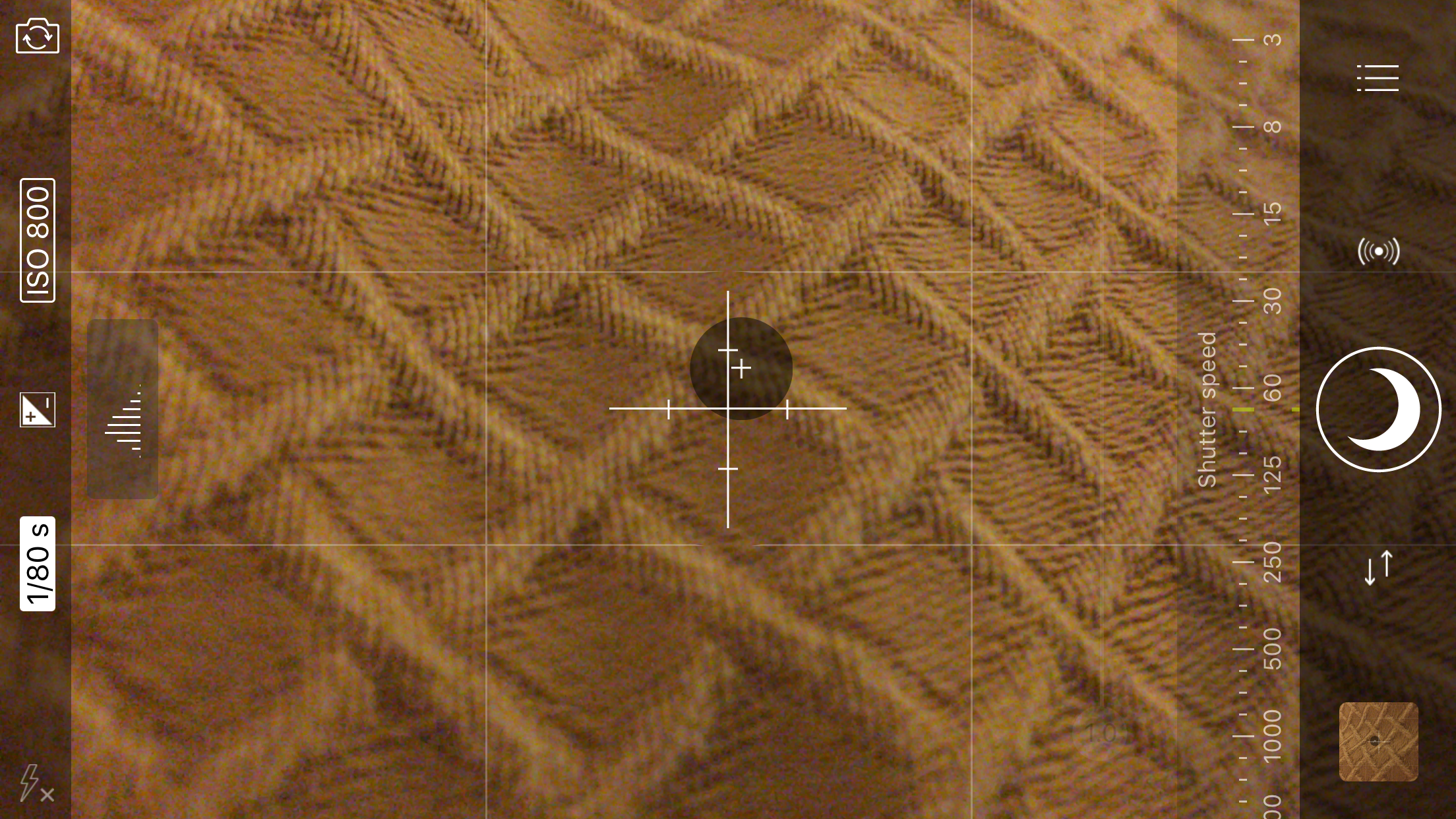
And that’s not all. This camera app does so much more. It naturally has all the manual controls as expected. 

  
And dependant on which mode you are in also depends on some of the options. 

Some of the modes require use of a tripod but the app tells you when you’ll need a tripod too. Low Light + mode is an advanced low light mode that combines 64 shots to create one low noise superb low light image. That’s right up to 64 shots !! The app is near magical in its performance.  The brand new LowLight Plus mode was developed in cooperation with Ittiam Systems. 


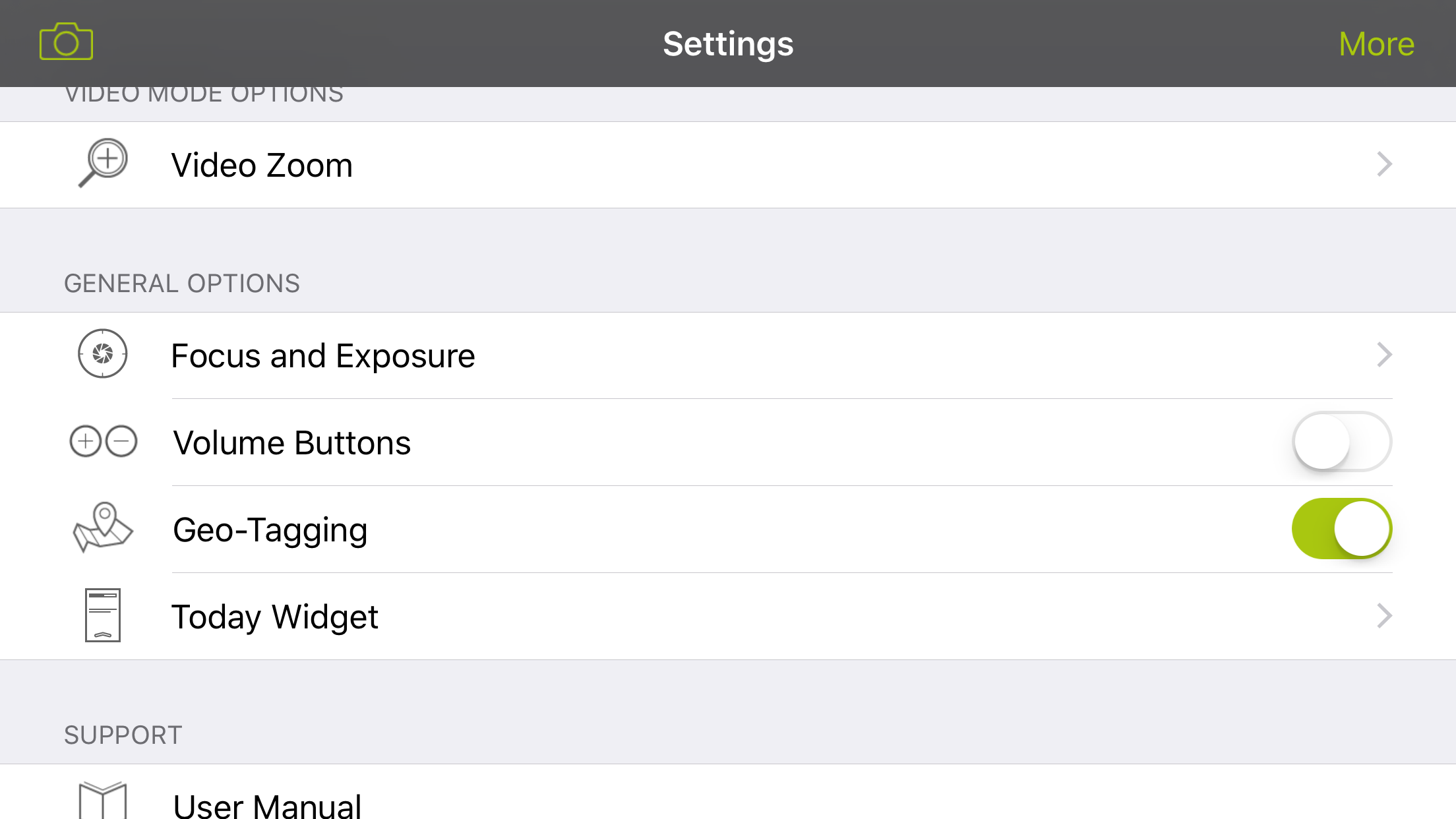
The settings are comprehensive with loads of fine tuning possible. 


You can even choose the method of stabilisation. 


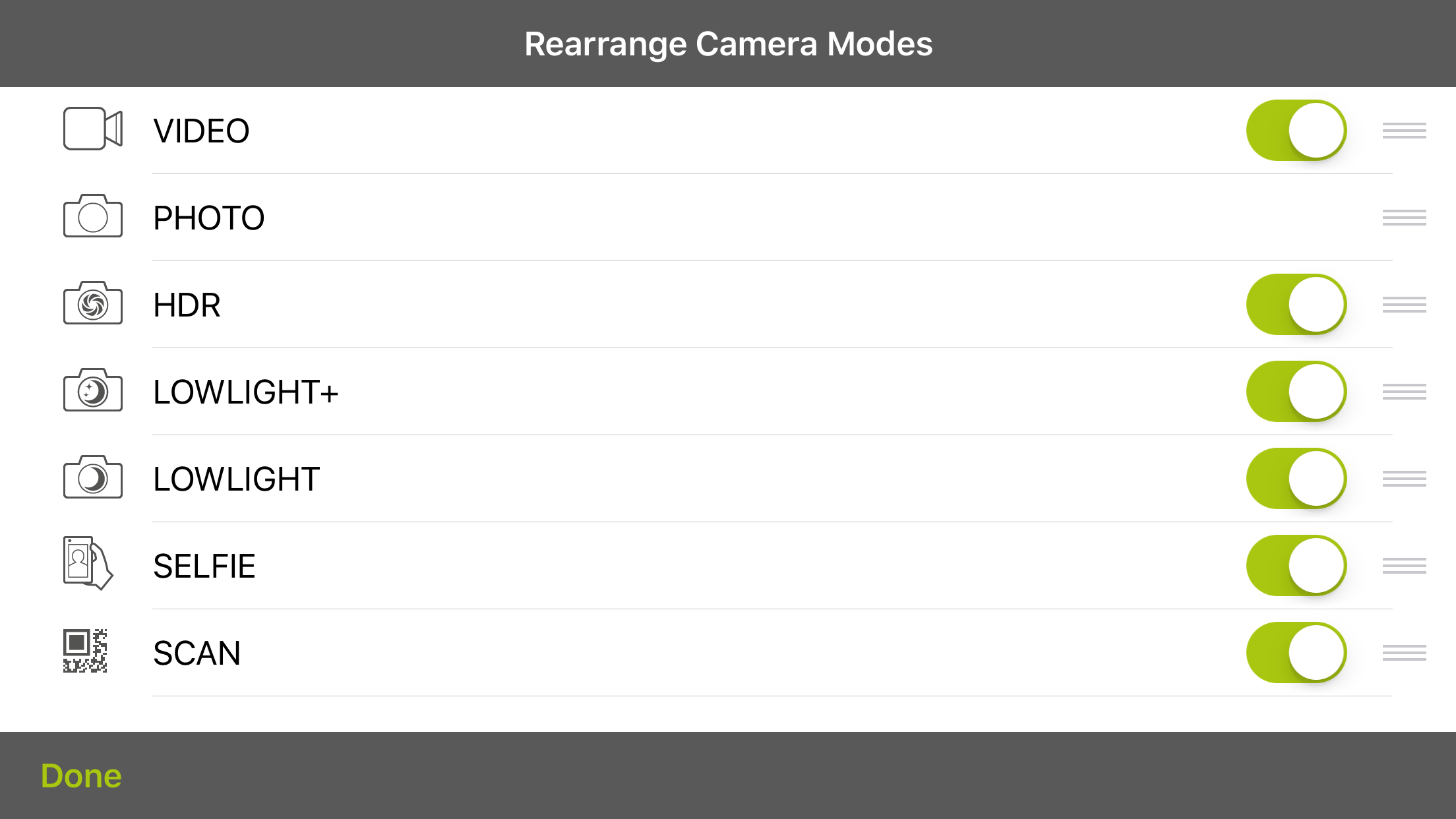
And if you want to, you can reorder the modes and turn off modes you don’t want to use. 

Of course after you have snapped a photo there is a full editing suite along with a good selection of filters. 


Anyway let’s take a look at some more photo examples. 


The above shot is lowlight HDR mode with the natural HDR selected. 

So how does the default camera app perform. 


The default camera app photo is a lot darker and has more noise. It also loses image quality. 

Now normal lowlight mode with ProCamera +. 


Zooming in on the chairs is really impressive. So much more detail and less noise. 

So what else does ProCamera + offer. Following its iOS 9 update it now supports Watch OS 2 so you can change the capture format , The HDR mode is full of options, there are 78 filters and effects, a special selfie mode, exposure swipe control , manual focus , full resolution photo preview, separate focus and exposure points , resolutions settings , cinematic 24fps for video and more. 

Now this app is not cheap. To get the full benefits of the lowlight + and special HDR extras you’ll need to buy the in app purchases. In total everything comes in around £11.30. 

However this app is so good it is on the verge of being my default camera app. 

More details at the developers website – Click Here 

LG V10 – How to turbo charge the Sabre Hi-Fi DAC sound quality


If you read my review of the LG V10, if not click HERE , you will have read that it has a Sabre 32bit Hi-Fi DAC. This means the V10 has a special high impedance mode for headphones from 50-300 ohms. 

With 50 ohm plus rated headphones, the V10 turns into a stunning digital audio player with lots of power and volume. It still sounds good in low impedance mode, but it’s worth triggering the high impedance mode to witness the difference. 

On XDA Developers somebody developed an app to trick the phone into the high impedance mode. I tried this app and it does t work. It also has other side effects reported by others. 

However, there is a much easier way to put the V10 into high impedance mode. This is achieved using an adapter. Being more precise you need a 10 cm 3.5mm Male to 3.5mm Female Auxiliary 4-Conductor TRRS Stereo Audio Extension Cable adapter as shown in the photo. You plug the adapter into the V10 first. This puts the V10 in AUX mode and switches the DAC to high impedance mode. Then plug your headphones into the adapter.  I would recommend dropping the volume right down to 15 out of 100 before you play any music as the potential volume in high impedance mode is massive. Just one small note is high impedance mode uses more battery. 

I bought a FosPower cable as shown above from Amazon. Including delivery it cost £4.99. Link below. As it came from the USA it did take a few weeks to arrive. 

FosPower cable for the LG V10 from Amazon UK

Pioneer XDP-100R Digital Audio Player – The First Digital Audio Player with MQA – My review 


Welcome to my review of the Pioneer XDP-100R Digital Audio Player.  The Pioneer XDP-100R is Pioneer’s first high-resolution portable music player. It is also the world’s first Hi-Res Digital Audio Player to support MQA technology. The Pionner XDP-100R retails for £499.

Master Quality Authenticated is a new music codec that packages Hi-Res and lossless files in a way that takes up significantly less space than current Hi-Res codecs. It is like the music is zipped and during playback gets unzipped. The other aspect of MQA is that it can still play on non MQA supported devices, albeit not at the same level of quality.

MQA can also be used in streaming services. That means much lower downloads too. Tidal is planning to support the MQA format in due course.

MQA support will arrive on the Pioneer XDP-100R via a firmware update fairly shortly.


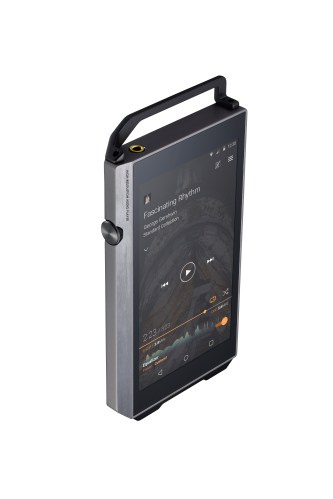
The XDP-100R is extremely well built using an aluminium frame. Just look at the photos. It has removable bumpers on the top and bottom of the device to stop headphones and the micro usb cable placing strain on the input sockets. That is a really neat touch.

The bottom edge also houses the loudspeaker. On the right hand side you have 2 micro SD card slots, music controls and the power standby buttons. The top is purely for the headphone jack and the left hand side is the volume control.

The Key Specifications –

– Aluminium build for extended durability strength with removable bumpers
– 4.7 inch (1280 x 720) touch screen for easily navigating music les
32GB Internal storage (Max 432GB capacity with 2 expandable SD slots)
Two (2) SD card slots for extended storage (Max 400GB/200 x2, Micro SDXC type)
– Built-In Wi-Fi® (802.11b/g/n or 802.11ac)
– Built-In Bluetooth® with aptX® (A2DP, AVRCP, HSP, OPP, HID, PAN)
– Built-in speaker
– 3.5mm Stereo Phone out
Micro USB B/OTG Digital out
– Battery Life: 16 hours (96kHz/24bit Playback)
Separate DAC/AMP circuit board and CPU circuit board
– Available in Black (XDP-100R-K) and in Silver (XDP-100R-S)
ESS SABRE® DAC ES9018K2M
Headphone AMP SABRE 9601K
– Qualcomm® APZ8074 Processor (2.2 gHz Krait 400 Quad-core, AdrenoTM 330 GPU 450 mHz)
Android 5.1.1 with Google Play
– X-DAP Link for content le transfer (PC to DAP)
– OnkyoMusic.com Direct Download
– Output Power – 75mW + 75mW 32 ohm
– Impedance Support – 16-300 ohm
MQA® playback support (with firmware update) DSD File Playback: Convert to PCM 192 kHz/24-bit (3.5mm Phone/Line-out mode)
– Up to 11.2 MHZ DoP/ Direct Transfer and Up to 5.6/2.8 MHz DoP/ Direct Transfer/ PCM (Micro USB-B)
– Hi Res file Playback:
– Up to 192 kHz/24-bit 32-bit Integer/ oat 24-bit down convert (3.5mm Phone/Line-out mode)
-Up to 384kHz/24-bit 32-bit Integer/ oat 24-bit down convert (Micro USB-B)
Sound Arrange Function:
– Up-Sampling 192kHz/24-bit (3.5mm Phone/Line-out mode)
– Up-Sampling 384Hz/24-bit Real-time DSD Convert 5.6MHz (Micro USB-B)
Six built-in sound adjustments (Lock range adjust, digital lter, upsampling to 384 kHz, Realtime DSD conversion to 5.6 MHz, High Precision EQ, Club Sound Boost)

Notes for this Review

FLAC and MP3 songs were used for this review. MP3 songs at 320 bit rate.

Headphones used included Sennheiser HD598se, Dunu Titan 5, Denon MM400, Audio Technica M50x and Sony XBA-A2.

Bluetooth headphones used were Plantronics BackBeat Pro and Lindy BNX-60.

The Operating System


Pioneer made a good choice and based the DAP on Google Android 5.1.1. That means that in addition to your own music you can stream music from all your favourites places. Tidal, Spotify and Qobuz are preinstalled.

APT-X is present for using Bluetooth. WiFi and DLNA is also present so streaming music to another device is possible.

The Pioneer XDP-100R runs a near stock version of android. Extra apps include Pioneer’s own music app and the Onkyo Music store app. This means you can buy Hi-Res music on the XDP-100R, then download and start enjoying your purchased music immediately.

The Sound Quality and Operation

The Pioneer will plays lots of different formats from MP3s to 24-bit/384kHz FLAC, DSD, WAV and AIFF files. The DAP has 32gb on board storage. You can then insert 2 x 200gb micro SD cards. Battery life is stated at 16 hours. In testing I achieved 12-13 hours but I was playing around a lot with the DAP.

Pioneer has included their own music app. And it’s seriously fantastic. And looks the business. You have tons of different ways to find your music. Upsampling options, club sound boost mode options , equaliser, crossfade, gain, USB Audio, digital filter options and much more. I like the fact that the song artwork becomes your home screen wallpaper automatically. This can be prevented if required. 

Playback via Bluetooth

APT-X is present for audio playback and the sound quality was superb using this method. For this test I listened to a number of different genres. I do like the fact that bluetooth is an option on this DAP. It really adds to its versatility. 

Playback via Wired Headphones

This is where the XDP-100R shines. As I mentioned above I tested the DAP with a range of different headphones to establish an overall opinion. 

FLAC – The Humming by Enza – The Pioneer recreates the delicacy of Enya’s voice superbly. The bass, treble and mids are all on the mark. It is worth pointing out that the volume increases from zero to 160 in small steps, allowing for precision volume control of all of your headphones. 

FLAC – Paavo Jarvi – Frankfurt Radio Symphony – Symphony No 1 in G Minor Op. 7 1 Allegro Orgoglioso – As the music escalates , the Pioneer XDP-100R keeps up nicely and delivers plenty of extra oomph as required. The sound is well balanced across all frequencies.  The sound field was reasonably wide too.

FLAC – Stravinsky Chamber Orchestra- Schindlers List – the piano is so moving. And delicate and precise. Wow. 

MP3 – Michael Buble – Feeling Good – Oh gosh Michael’s voice is delivered with such authority, slam and attack. The bass is fantastic. Accurate and firm and not over the top. 

MP3 – Nina Simone – The Other Volume – Nina’s voice is reproduced so well and with such musicality and feeling. The piano and other instruments are all clearly heard too. 

MP3 – Paloma Faith – Can’t Rely on You – a punchy powerful reproduction with the XDP-100R. All the vocals are superb with a strong bass line. 

MP3 – Muse – Defector – A powerful musical rock performance by the Pioneer. Stunning. 

MP3 – Gypsy Kings – Moorea – the guitar playback and rythym is beautiful. 

In fact my main takeaway with the Pioneer XDP-100R is the fact it possesses such musical, engaging and powerful sound qualities. I found I could close my eyes for hours and hours and enter a different world. 

All my headphones sounded brilliant with the Pioneer. The Sony XBA-A2 are fairly bass neutral / light but with the Pioneer they came alive. The Pioneer possesses superb bass attack, treble and mid range. Where appropriate the sound stage is dynamic and wide. The toe tapping musicality of this device makes this one additive machine. 

Conclusion

The Pionner XDP-100R is a great entry by Pioneer into the personal digital audio space. It is future proof with MQA codec support and versatile with WiFi, DLNA and Bluetooth APT-X and the ability to add 2 high capacity micro SD card support. In addition, it offers superb sound quality making the whole package rather attractive. Highly recommended.

Pioneer XDP-100R-K High Resolution Digital Audio Player deal on Amazon UK

LG V10 H960 Smartphone – My Review – The Phone that Has Everything

img_2363

Welcome to my review of the LG V10 smartphone. This is the H960 version, which means its the official European/UK model which includes all the LTE bands. My thanks go to Clove Technology for their speedy service in sending the LG V10.

The Key Specifications

– Processor Qualcomm Snapdragon 808 Processor, Adreno 418 GPU
– Main display 5.7-inch QHD IPS Quantum Display 513ppi
– Secondary display 2.1-inch IPS Quantum Display, 160 x 1040, 513ppi
– MIL-STD-810G certified – shock resistant
– Infra Red Blaster
– Memory4GB LPDDR3 RAM / 32GB storage plus microSD
– Rear camera 16MP with F1.8 Aperture/OIS v2.0
– Front camera 5MP Dual Lens 80-degree Standard Angle/120-degree Wide Angle
– Battery 3,000mAh removable
– Operating system Android 5.1.1 Lollipop
– Size 159.6 x 79.3 x 8.6mm
– Weight 192g
– Network LTE-A Cat. 6
– Connectivity Wi-Fi 802.11 a, b, g, n, ac, Bluetooth 4.1, NFC, USB 2.0
– Quick Charge 2 – 50% charge in 40 mins
– Manual mode for video – ISO, Shutter, White Balance, Frame rate, Focus, new 21:9 cinematic mode
– Electronic video stablisation
– Audio extras – 32-bit Hi-Fi DAC electronic processor
– Qualcomm’s QFE2550 closed-loop antenna tuning – first phone to deploy for better voice and network reception


Phone Section

The LG V10 improves upon the LG G4 from the moment you insert your sim, as its takes a nano sim. The G4 used a micro sim. As a phone it is versatile with a user removable battery, micro SD card support up to 2TB and is MIL-STD-810G certified – shock resistant. The V10 is designed to withstand drops. The back cover is grippy which is needed for a phone of this size. In terms of its overall size it is the same size as an iPhone 6S Plus.

The H960 version is made for the European and UK markets and includes all the LTE bands for the UK. For some unknown reason, LG also took it amongst themselves to reduce the internal storage down to 32gb from 64gb. However, you can still add a micro SD card slot. My 200gb Sandisk card works perfectly.

Viewing angles are excellent. Call reception is very good too and callers had no trouble hearing me at the other end of a call. WiFi, NFC and bluetooth all performed admirably. AnTuTu scored 59,106. Performance is smooth across all apps. The V10 has Qualcomm’s QFE2550 closed-loop antenna tuning and is the first phone to deploy this tech for better voice and network reception.

The V10 has a fingerprint sensor on the rear. To activate this you need to press it and hold it at the same time. It isn’t as reliable as the fingerprint sensor on other phones like the iPhone 6S or Huawei Nexus 6P but it is reliable enough to leave it on. 2/10 failed at first attempt to unlock the phone.

In the box are the Quadbeat 3 in ear headphones/headset tuned by AKG. These are better than average headphones.

One of the unique aspects of this phone is the secondary display. When the screen is off, the secondary display is always on. With the display off you can scroll 3 times as shown below.


And when screen is on you get a choice of what options you would like to show. 


Now at first some of you might be thinking this is surely a gimmick. Actually it isn’t and becomes very useful in practise. For example, you are in an app, a notification appears on the secondary display. You can read it without having to leave the app you are in. Using the camera pushes extra options on to this section. If you are listening to music, you have the music controls always accessible.

The V10 continues to include a wealth of other features. More than you can ever imagine. Quick Slide apps are mini apps that can be left floating on the screen, resized along with the transparency. Miracast, Dual Screen mode, NFC, Infra Red Remote Control Blaster (for TV, DVD etc) and a Sabre 32 bit HiFi DAC and Amp are all included.

The loudspeaker is located at the rear of the phone. It goes louder than the G4 and is a lot clearer too. I will cover off the headphone quality later on, but needless to say this phone rocks an awesome DAC and headphone amp.

Battery. The battery will last a day with an average of 4-4.5 hours screen on time. Quick charge 2 is available and this works as expected.

The Camera

The V10 camera is phenomenonal. Firstly the secondary display becomes handy for changing main camera modes.  The main camera modes are simple (tap screen to take picture), auto, manual photo, manual video and snap mode. Snap mode assembles short video clips into a 60 second short film. From the photos, you will also notice the V10 has 2 front facing 5mp cameras. One is a 80-degree Standard Angle and the 120-degree Wide Angle. If you are using the front facing camera, you decide which one you would prefer to use.


Within Auto mode you gain access to a few shooting modes as shown all of which work really well. Panoramic shots are excellent too.


In terms of photo and video sizes, the options are limited.


If you are in manual photo mode, other options appear in the setting dialogue include a histogram option.


In manual mode you have the option of shooting in RAW format. 


Manual video mode introduces even more options in the settings. 


And more options. 


And more again. Even the bitrate can be changed from High, Medium or Low. 


The manual video mode then provides granular controls of all aspects of taking photos. The shutter can stay open for 30 seconds. In all honesty the V10 provides one of the best camera experiences I have ever seen on a smartphone. But even if you just leave it in auto, you will still end up with incredible photos. HDR can be left in Auto and therefore turns on as required.

Camera Samples

Below are just a few samples from the V10 camera. I have taken hundreds of shots and the results are incredible. The photos of my dogs have been the best ever in terms of quality. The below shots were all taken in auto, except for the salt crystals which was snapped in manual mode.

Around Exeter Cathedral Yard #LG #V10

Buildings or large panoramic shots are a breeze for the V10.

Fury posing on Dartmoor #LG #V10

As you can see the dogs motion is frozen really well.

That's one large smile from Tiggy #Dartmoor #LG #V10

Even fog and heavy rain was not too much of an issue for the V10. I use the shot below as my screen saver.

Extreme Fog, Live Weather Shots from Princetown #LG #V10

And finally, a macro shot. White on white for the salt crystals. Very good.

Salt crystals #macro #LG #V10

I have tested the video too, and it is significantly better than anything else at the moment. Stabilisation has been improved too. Plus there is the ability to use manual controls for video which is such fun.

Audio and Sound Quality

The V10 was not just about everything else mentioned above, but also the sound quality. The loudspeaker is on the bottom of the phone and is above average in quality. Where the V10 shines is with headphones. It has a Sabre 32-bit Hi-Fi DAC electronic processor and regardless to whether I listened to FLAC or MP3 tracks, the quality blew away all other smartphones I have used when it came to headphone quality and volume output. If you like listening via bluetooth, the V10 includes APT-X and produces stunning sound via this method.

wp-1453404663994.png

The V10 goes one step further. It is compatible with headphones from 50 ohms to 600 ohms. When a headphone is connected in this range, it switches to high impedance mode. So plugging in my Sennheiser HD598 headphones, the V10 switches to high impedance mode and adjusts the volume output to enable the V10 to power these headphones effortlessly and to a very high volume.

Conclusion

At first you may have some belief that this is just a small upgrade to the LG G4 or Flex 2. In fact, the total sum of all its parts ensures it is significantly better in its user experience, camera, audio and so much more. With improvements in durability (drop proof), design, the second screen, the best camera on a smartphone currently for video and photos, fingerprint sensor, Sabre HiFi DAC, Quick Charging 2 and overall feel in the hand, it is my top phone of the year. Now in case you’re thinking that the new flagships from Samsung, LG and others are that coming out next month will surely surpass the LG V10, well that is a possibility. However, I believe that the features and lower cost of the V10 will still keep it at the top of pile. 

Extremely recommended by myself.

Once again thanks to Clove Technology for their speedy service. Currently, if you order via Clove you get a pair of bluetooth gloves for free.

img_2364

Lindy BNX-60 – Wireless Noise Cancelling Headphones – My Review


Welcome to my review of the brand new Lindy BNX-60 bluetooth wireless headphones with noise cancellation and APT-X.  


The Lindy BNX-60 are the latest wireless headphones from Lindy just announced at CES 2016.

In the Box

– BNX-60 Headphones
– 1.5m audio cable with 3.5mm jack
– 1/4” stereo-plug adapter
– Dual-plug flight adapter
– Micro USB charging cable 80cm
– Hard carry EVA case with mesh pouch
– User manual

Key Specifications

– 10m Wireless Range (depending on environment)
– 40mm high output drivers with neodymium magnets
– Impedance: 32Ohm passive mode / 100Ohm Active Noise Cancelling mode
– Sensitivity (1mW@1KHz ±3dB): Passive 93dB ANC 103dB Bass 104dB
– Nominal THD: Passive <0.1%@ 1KHz / Active <0.5% @ 1KHz
– Frequency response: 20Hz – 20KHz
– Built-in 3.7V 320mA Lithium Polymer Battery
– Battery Life: 30Hr ANC Only, 15Hr Wireless Only, 12Hr ANC & Wireless
– Charges via USB Micro-B, approximately 3 hours to fully charge
– Integrated Audio (FF/RW, Play/Pause) & Handsfree Calling Controls
– Adjustable volume
– 3.5mm Stereo Jack Socket for detachable 3.5mm audio cable

Operation and Sound Quality

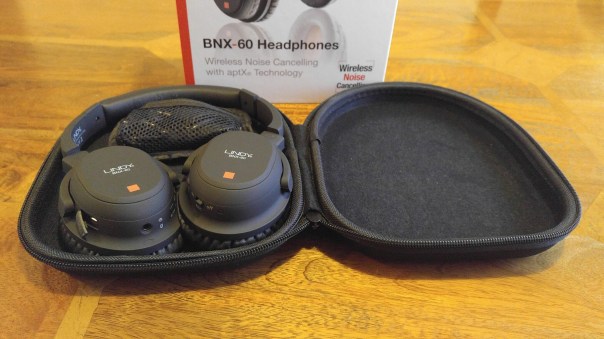
The Lindy BNX-60 headphones are very well designed with a lot of thought and attention to the extras included. First up you get a decent hard case. No more worries about breaking these in transit. Secondly, the hard case has a velcro detachable zipped pouch which houses the 3.5mm audio cable, micro USB lead for recharging and the airplane and 6.3mm adapters. I thought the velcro detachable pouch was a neat touch.

As you can see from the photos the headphones have lots of controls on the ear cups. This means you can control your music and take phone calls. Phone calls were clear and the caller at the other end had no problem hearing me. On the right ear cup is the automatic noise cancellation on off switch and volume control.

The automatic noise cancellation can be turned on independently of the bluetooth connection. With the noise cancellation switch on, the sound stage is pushed forward slightly and the treble becomes more pronounced. There is also a very very slight amount of hiss. Lindy state that 85% of low frequency noise is removed. In my testing the headphones did make a noticeable difference removing outside sounds with the noise cancellation switched on. Without the noise cancellation switched on the treble/mid is slightly pushed back in the sound stage. Bass is solid and punchy but not over the top. The BNX-60’s has APT-X which do make a difference if your device also is compatible with APT-X. I also connected the audio cable to my LG V10 smartphone and was surprised that the sound quality was reasonable. I listened to as many different genres as possible and enjoyed the sound produced by the Lindy BNX-60 headphones.

Comfort. The Lindy BNX-60 headphones are light and comfortable to wear.

Conclusion

A versatile solid offering from Lindy Headphones. Comfortable, bluetooth, noise cancellation, APT-X and a carry case makes this a recommendation from me.

LINDY BNX-60 – Bluetooth Wireless Active Noise Cancelling Headphones with aptX deal on Amazon UK

LG V10 Smartphone, Lindy BNX-60 Wireless Headphones and Pioneer XDP-100R Digital Audio Player

Reviews coming up soon on Gavin’s Gadgets.

LG V10 Smartphone

img_2363

Next week my review of the LG V10 smartphone, focusing on what’s different to other flagships by LG, namely the LG G4 and LG Flex 2.

Pioneer XDP-100R Digital Audio Player

XDP-100R-K_1

I have been testing the brand new Pioneer XDP-100R Digital Audio Player will have the review of this stunning piece of audio tech ready to publish either by the end of next week or Monday the week after.

Lindy BNX-60 Wireless Headphones

photostudio_1453889448673

Monday will be the review of the newly announced at CES 2016, the Lindy BNX-60 Wireless headphones.

If you have any questions on any of these items then please let me know and I will attempt to answer them in my reviews.