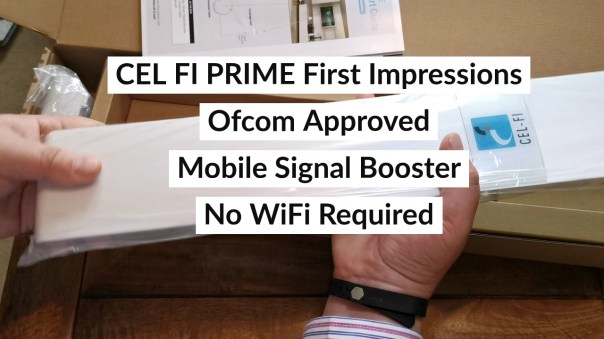
Welcome to my First Impressions and Unboxing of the CEL-Fi Prime mobile signal booster.
Key Features
– 100 dB maximum signal gain covering 1 to 2 rooms
– Ideal for dense, high rise urban areas
– Carrier approved for 3G/4G/LTE for voice and data; Cel-Fi Prime is CE and FCC approved; it is legal to use and has been approved for use by mobile operators, Ofcom approved
– Intelliboost chipset – unconditionally network safe
– Quick setup with integrated antenna system and Wave app management
– Boosts both 3G and 4G signal coverage – you must have at least one bar of signal somewhere in the building
– No WiFi needed
– Solves pilot pollution with innovative beam steering
– Unconditionally network safe
– UK Retail price £399
The CEL-Fi product range offers a cost effective solution for addressing poor signal coverage when at home or work. All you need is at least one bar in the building. This solution does not require WiFi either. All CEL-Fi prodducts comply with OFCOM regulations.
Welcome to my review of the iFi Audio xDSD. The iFi Audio xDSD retails for £299.
Key Features/Specifications
– Wirelessly connect any smartphone or digital audio player to wired headphones.
– APT-X and AAC Bluetooth streaming receiver.
– USB type A OTG/CCK connector.
– 3.5mm coaxial/TOSLINK combo S/PDIF input.
– Sensitive IEMs are super quiet using iFi Audio Cyberdrive circuit design (incorporates the iFi exclusive OV4627 ultra low noise FET input Op-Amp and W990VST digitally controlled stepped attenuator) which puts the analogue volume under digital control.
– Natively playback Hi-Res audio with iFi Audio signature Burr Brown digital to analog converter chip. Supports native PCM 384, quad DSD 256, and MQA.
– 3.5mm balanced output works with single ended connections and cuts crosstalk in half.
– XBass – cleans up and restore a rich, deeper bass line.
– 3D Matrix- recreates the recording’s original sound field.
– Two modes – speakers or headphones.
– Up to 10 hours battery life.
– MQA included. Stream Tidal with ease.
– True Native® playback of all music formats from MP3 to DSD512, PCM768 and 2xDXD.
– Separate power input (micro USB) to charge its own internal battery, it does not draw from your smartphone
– Dynamic Range > 113dB (A)
– Output power – 2.82V/500 mW @ 16 Ohm, 3.7V/270 mW @ 50 Ohm, 3.8V/48 mW @ 300 Ohm, 3.8V/24 mW @ 600 Ohm
– Line out Level – 2.1V @ 0dBFS
– Dimensions 95(l) x 67(w) x 19(h) mm
– Weight 127g
Main Review
Conclusion
The iFi Audio xDSD is a cracking versatile piece of kit and highly recommended.
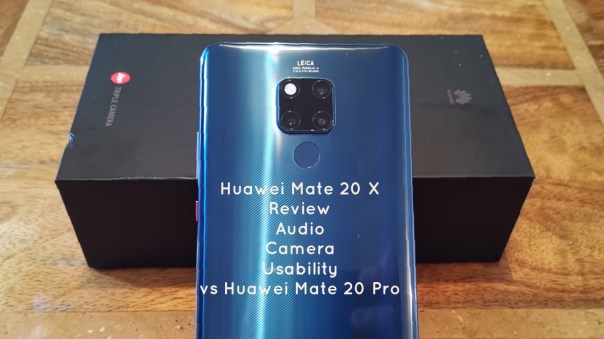
Welcome to my review of the Huawei Mate 20 X smartphone.
My review is split into several parts. A comparison with the Huawei Mate 20 Pro, usability and UI, Audio, Camera and final verdict. The audio section includes a loudspeaker shootout between the Mate 20 Pro as well.
Key Features
– 7.2 inch OLED 1080p screen
– Kirin 980 Processor 7nm
– 5,000 mAh battery with TÜV safety-certified HUAWEI SuperCharge
– GPU 2.0 Turbo Technology
– Dual symmetrical speakers at both ends of the device, plus a super high dynamic range up to 40 db
– The world’s first liquid multi-dimensional cooling system with Vapour Chamber (VC) and Graphene Film used in smartphones.
– 40 MP main RGB lens captures great details in everyday photos, while the 8 MP telephoto lens will focus on your distant shots and the whole new 20 MP Leica Ultra Wide Angle Lens is perfect for the landscape photos and macro shots.
– 24 MP front camera
– AI Video Modes
– AI Cinema Mode and Directors Cut
– M Pen stylus (optional)
– Wireless Projection, Desktop mode
Main Review
Conclusion
The Huawei Mate 20 x is an incredible media machine and highly recommended if you can live with its footprint.
For this review I have focused on the photo quality as this is the Pixel 3 forte.
The Pixel 3 or 3 XL feature a camera that in auto mode delivers a good photo pretty much every time. Video quality is good but Google decided not to include 4K 60fps. Also the video audio quality is sub par compared to its major competitors like the iPhone Xs, Samsung Note 9 and Huawei Mate 20 Pro.
The Pixel 3 manages to use its single rear lens to great effect but ultimately the super res zoom cannot compensate for proper optical zoom. It also is competing in a world where phones are having 3 or more lenses on the rear which translates into extreme flexibility.
Despite this, for portrait/people shots it really performs exceptional well. Take a look at the video review. There is a front camera shot at night. The level of detail was astonishing. The front cameras include a normal and wide lens to allow you to get more people or more of the background in the shot.
The Pixel 3 Camera also takes shots with fantastic detail and dynamic range. The new night sight mode turns darkness into daylight.
Pixel 3 Camera Review
Conclusion
If you predominantly take photos, you cannot go wrong with the Pixel 3 or Pixel 3 XL.
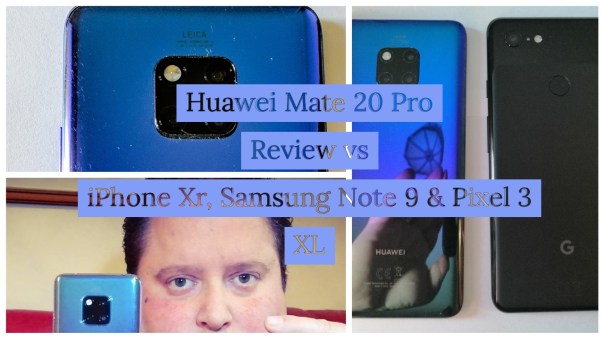
The Huawei Mate 20 Pro review. This is my review after using the phone for one month.
Key Features
The Huawei Mate 20 Pro features the new Kirin 980 7nm chipset, with its dual NPU. This is so important as it ups what’s possible in the photography field, but does this translate into video as well? More in my video review below. The video options extend to some flashy Video AI options eg Video AI colour which keeps the person(s) in colour and everything else in black and white.
In terms of connectivity, the phone has Cat 21, that’s 1.4 Gigabits per second. The latest Bluetooth 5 is now included with the respective codecs. the Mate 20 Pro has a huge 4,200 maH battery. Not only that it has “Reverse Wireless Charging” – a first for a phone to share power wirelessly.
Unlike Apple, Huawei include a supercharger in the box. This is the new 40Watts supercharger that can recharge the huge battery to 70% in just 30 mins. Qi Wireless is now included at 15 watts which is double the industry standard. Both charging methods have been safety certified by independent company.
The Mate 20 Pro is all about its camera and I am sure that is what you are all most interested in. Co-engineered with Leica and taken up to the next level. On board is a 40mp RGB f/1.8 lens, 8mp telephoto with OIS, 20mp f/2.2 ultra wide sensor, dual tone flash. As the main sensor is so good now, there is no need for the monochrome sensor. Front camera is 24mp fixed focus.
The Mate 20 Pro features new photo AI modes. Super macro gets as close as 2.5cm from subject. On the P20 Pro, it could identify 500 scenes and scenarios, but now with dual NPU that has risen to 1,500. The AI knows how to keeps the right stuff in focus too. There is so much to cover on the cameras, so I have created to separate videos so far on the camera. See below.
Part 1 – Camera Review includes the Camera App UI with explanations, tips and tricks and sample footage from all modes
Part 2 – Based on new firmware, another look at the video improvements and new features
Security has been improved with a new 3D Facial dot matrix unlock. It can be used to secure information on the device as well. An under the screen finger print sensor is also included. Huawei’s backup now extends to NAS systems for extra versatility.
Moving over to productivity, you can now print seamlessly to a wifi printers. PC Desktop mode is now wireless enabled using a miracast enabled screen/TV. This also means you can use desktop mode indepently of the phone.
The design of the phone and camera setup is distinctive and easily identifiable. It has glass with a textured pattern to aid grip, resists fingerprints. Beautiful and practical. It is also IP68.
The sound and audio functionality of the Mate 20 Pro has been improved with some neat tricks. Below is an in depth look at the speakers, bluetooth, USB C earphones and more, plus some headphone recommendations.
Main Review
Let’s move to the main review now, where I will cover off all my key findings and recommendations after using the phone for a month.
Conclusion
The Huawei Mate 20 Pro is a fabulous phone from Huawei feature packed to the gills with technology and innovation.
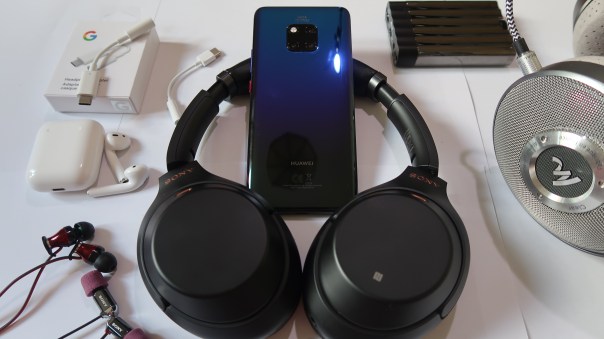
Welcome to my Huawei Mate 20 Pro Audio review. This review looks at the audio quality covering bluetooth, loudspeaker, the included USB C earphones and USB C to 3.5mm dongle, using other USB C dongles and DACs and which headphones are best.
Key Audio Features
– 32-bit/384kHz audio
– Active noise cancellation with dedicated mic
– Bluetooth 5.0, BLE, SBC, AAC, aptX, aptX HD, LDAC and HWA Audio
– USB 3.1, Type-C 1.0 reversible connector, USB On-The-Go
– DivX/XviD/MP4/H.265/WMV player
– MP3/eAAC+/WMA/WAV/FLAC player
So how does all the above specs translate into audio quality. Lets take a close up look now.
If you wish to get a Huawei Mate 20 Pro and all accessories, check out the options on Amazon UK
Welcome to my Huawei Mate 20 Pro Camera Review. In this review I have tested all the photo and video modes, explained the camera app interface and UI, sort of a mini tutorial, plus you get to see what the max resolutions are per mode.
So what lenses does the Mate 20 Pro have? 4 in total. 3 rear lenses, a 40mp main sensor, a 20mp ultra wide and a 8mp telephoto lens. The front camera is 24mp. The camera system is co-engineered with Leica.
Below are some photos from the camera.
A very windy day, but I still managed a close up of a bee feeding.
With the sun behind the church entrance, the ultra wide lens created a lovely effect.
My camera review includes shots of the moon, high action, pitch black, low light, all video modes, Video AI, stabilisation tests, zoom tests and much much more, plus my honest verdict on the whole phone from just a camera point of view, and then compared to the iPhone Xs Max and Note 9.
Of course, the Mate 20 Pro has many other unique or great features, like fast wireless charge, reverse wireless charging and did you know the bottom speaker is integrated into the USB C port!
The Main Event
Get the Huawei Mate 20 Pro and all accessories on Amazon UK.
Welcome to my First Impressions and Hands on with the Huawei Watch GT.
The Huawei Watch GT compliments Huawei’s wearable family. It runs Huawei’s own operating system, Lite OS. The Watch GT is an extension of Huawei eco system.
With the Watch GT, Huawei wanted to create something similar to Garmin and Fitbit. However, they also wanted the watch to look like a sports watch.
Some of the feature highlights includes a superb battery life. It has the potential for 22 hours with continuous everything. This is with GPS on and continuous heart rate monitoring. More realistic and what most people will achieve is up to 2 weeks with general usage. Or if you restrict the background activities the battery will last up to 30 days.
Apart from Huawei using their own OS, it also has their own chipset with a low and high power core, which will kick into action, depending on what’s needed by the user. Some of the fitness features include real time performace when running, a heart rate system now uses a 6 system light system to read heart rate. It uses the sensors and AI to understand where the watch is precisely placed on your wrist to give you more accurate readings. GPS location is derived via 3 different GPS systems to help triangulate more accurate and faster tracking. The Huawei Watch GT also includes an altimeter.
In terms of compatibility, the Huawei Watch is compatible with iOS and android. Data is synced and displayed using the updated Huawei Health app.
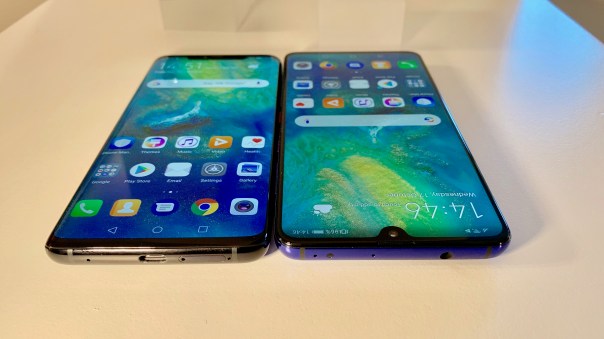
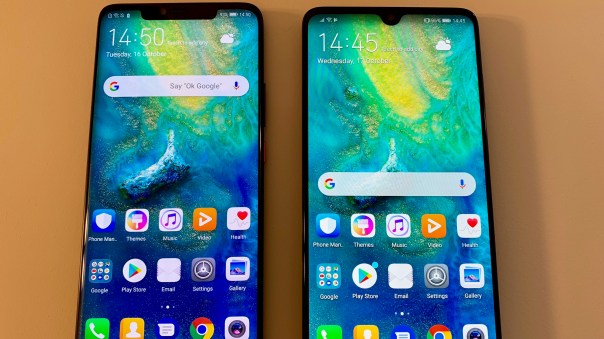
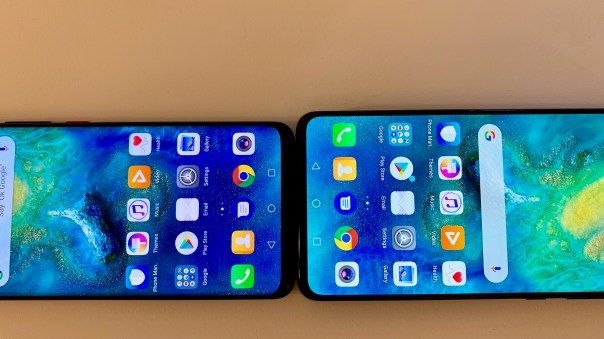
Huawei has just announced several new smartphones. So let’s take a look at the differences between the Huawei Mate 20 Pro and the standard Mate 20.
First up the standard Mate 20 has a wider body. It also lacks a notch as it doesn’t have the Dot Matrix Face Unlock system that the Mate 20 Pro includes.
Eagle eyed people will also notice the standard Mate 20 has a headphone jack.
Not shown, but both feature the same look/design of rear camera configurations, but the Mate 20 Pro comes with a superior configuration.
So which do you prefer? The Huawei Mate 20 or Mate 20 Pro?
The Huawei Mate 20 Pro is the new flagship phone from Huawei. I am very excited about this new phone, having spent some early access time using it.
Key Features
First up it features the new Kirin 980 7nm chipset, with its dual NPU. This is so important as it ups what’s possible in the photography field. Now the Huawei Mate 20 Pro can recognise the skeleton form of a human being, not just photos, but in videos in precise detail. This means it can optomise parts of images live even during video. See my video below with the sample of Video AI colour.
In terms of connectivity, the phone has Cat 21, that’s 1.4 Gigabits per second. The latest Bluetooth 5 is now included with the respective codecs.
What’s a phone without a decent battery? Well the Mate 20 Pro has a huge 4,200 maH battery. Not only that it has “Reverse Wireless Charging” – a first for a phone to share power wirelessly.
Unlike Apple, Huawei include a supercharger in the box. This is the new 40Watts supercharger that can recharge the huge battery to 70% in just 30 mins. Qi Wireless is now included at 15 watts which is double the industry standard. Both charging methods have been safety certified by independent company.
The Mate 20 Pro is all about its camera and I am sure that is what you are all most interested in. Co-engineered with Leica and taken up to the next level. On board is a 40mp RGB f/1.8 lens, 8mp telephoto with OIS, 20mp f/2.2 ultra wide sensor, dual tone flash. As the main sensor is so good now, there is no need for the monochrome sensor.
The Mate 20 Pro features nNw photo AI modes. Super macro gets as close as 2.5cm from subject. On the P20 Pro, it could identify 500 scenes and scenarios, but now with dual NPU that has risen to 1,500. The AI knows how to keeps the right stuff in focus too. There is so much to cover on the cameras, so much so, I will be creating two special posts.
The AI now extends to video with special video modes eg AI Colour video. This keeps the person in colour while the res of video is in black and white.
Security has been improved with a new 3D Facial dot matrix unlock. It can be used to secure information on the device as well. An under the screen finger print sensor is also included. Huawei’s backup now extends to NAS systems for extra versatility.
Moving over to productivity, you can now print seamlessly to a wifi printers. PC Desktop mode is now wireless enabled using a miracast enabled screen/TV. This also means you can use desktop mode indepently of the phone.
The design of the phone and camera setup is distinctive and easily identifiable. It has glass with a textured pattern to aid grip, resists fingerprints. Beautiful and practical. It is also IP68.
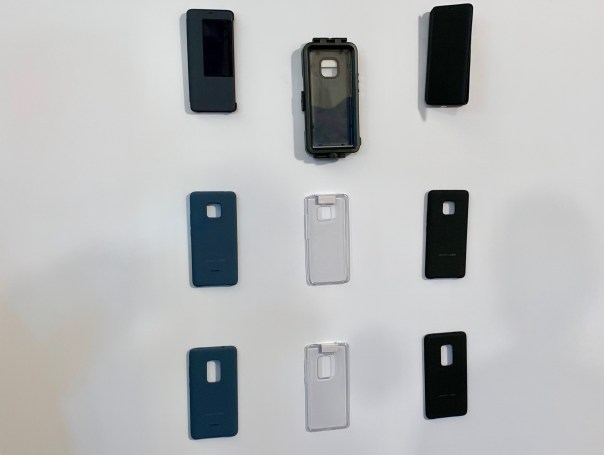
Accessories
Huawei are bringing a selection of cases with the new phones as well as the new fast 15w Qi charger.
First Impressions
Conclusion
I am genuinely bowled over by the Huawei Mate 20 Pro and can’t wait to explore if further!






 Gavin's Gadgets & Photography